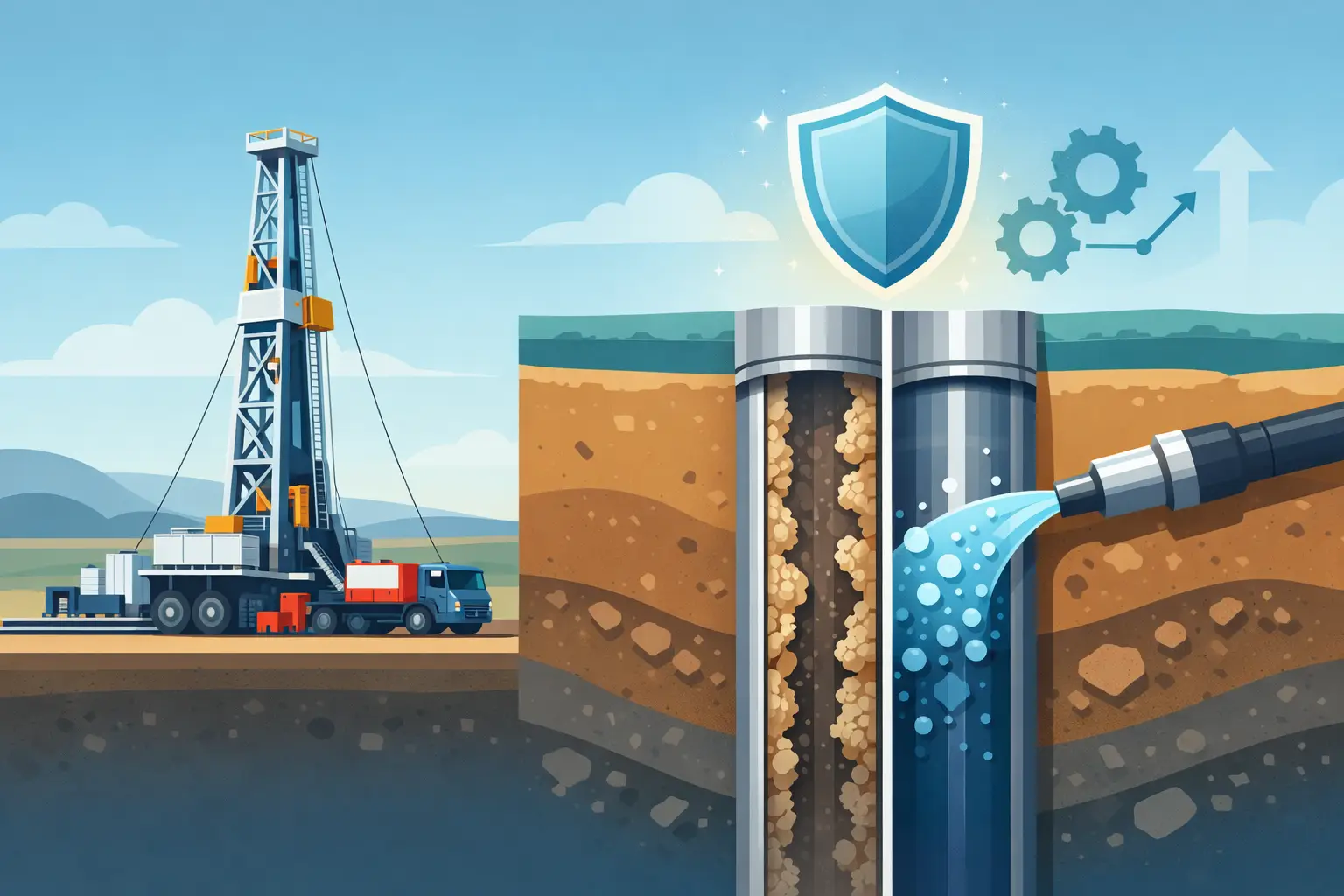
A well that is loading up with scale rarely gives an operator the luxury of a clean, isolated maintenance window. Production rates fall, pressure behavior changes, injection performance slips, and restrictions can turn a routine service call into a workover. Wellbore scale remediation needs to be planned around the actual restriction, the completion, fluid compatibility, pressure control, and the equipment required to keep the job moving.
For Central Ohio operators, the practical issue is not simply removing deposits. It is restoring well access and production without creating a larger problem below the surface or at the location. That takes the right treatment method, a service-rig crew that can execute the workover scope, dependable fluid handling, and enough logistics capacity to avoid waiting on another vendor when the job is already underway.
What Makes Wellbore Scale a Workover Problem
Scale forms when produced-water chemistry, pressure changes, temperature shifts, and incompatible fluids push dissolved minerals out of solution. Calcium carbonate, barium sulfate, strontium sulfate, iron compounds, and mixed deposits can accumulate across perforations, in tubing, around downhole equipment, and through surface flow paths. The composition matters because the material that responds to an acid treatment may not respond at all to the wrong chemical program.
The location matters just as much. A restriction near the top of tubing presents a different job than scale packed around a pump, bridging across perforations, or restricting injection intervals. A well may show declining production because of scale, but it may also have paraffin, fines migration, corrosion products, tubing damage, pump issues, or formation impairment. Treating every decline as a chemical-scale job is an expensive way to miss the real failure mechanism.
Before mobilizing, operators should establish what has changed in the well. Production and pressure trends, water analysis, previous treatment records, tubing and completion history, and any available sample data help define the scope. If the well needs to be pulled, tagged, circulated, mechanically cleaned, chemically treated, or returned to production under a controlled flowback plan, those decisions should be made before equipment starts rolling.
Choosing the Right Wellbore Scale Remediation Method
The best remediation program is dictated by deposit type and placement, not by whichever treatment is easiest to mobilize. Mechanical and chemical methods are often used together, particularly when the well has a hard restriction that must be opened before a treatment can reach the affected interval.
Mechanical removal when access is restricted
When scale has significantly reduced tubing ID or is interfering with downhole equipment, mechanical work may be the first step. Depending on the completion and condition of the well, the scope can involve pulling tubing, scraping, milling, jetting, bailing, or running tools to clear the restriction. This approach provides physical confirmation of what is in the well and can restore access where a chemical treatment alone would struggle to penetrate.
Mechanical removal has trade-offs. It requires a service rig, pressure-control planning, handling space for tubulars, and a clear plan for solids and fluids recovered from the well. It can also expose worn tubing, failed rods, damaged pump components, or corrosion that was hidden by the original scale problem. Those findings can expand the scope, but identifying them during the workover is preferable to returning the well to service with a known mechanical issue still in place.
Chemical treatment when scale chemistry supports it
Chemical remediation can be effective when the deposit chemistry is known and the treatment can contact the affected area. Acid systems may address carbonate scale, while sulfate scales generally require specialty dissolvers, chelants, or other targeted chemistry. Treatment design should account for metallurgy, elastomers, formation sensitivity, produced-water chemistry, treatment temperature, contact time, and disposal requirements.
Pumping a chemical without confirming compatibility can create corrosion exposure, precipitate additional solids, damage equipment, or leave the restriction substantially unchanged. The field objective is not maximum chemical volume. It is adequate contact, controlled placement, proper dwell time, and recovery of spent fluids under a plan that fits the well and location.
Hot oiling has a role in many maintenance programs, but it should not be treated as a universal scale solution. Hot oil can help manage waxy or organic restrictions and can support circulation work where appropriate. Mineral scale requires its own diagnosis and treatment approach.
Combined workovers for persistent deposits
A combined program is often the most dependable option for mature wells and heavily restricted completions. Mechanical cleaning restores a flow path, a targeted chemical treatment addresses remaining deposit, and a controlled return-to-production plan verifies whether the work delivered the expected result. This sequence costs more than a single treatment call, but it can reduce repeat downtime when the restriction is substantial.
Field Support Determines Whether the Plan Holds
Scale remediation is not only a downhole treatment decision. It is an execution job. The crew needs to manage rig-up, pulling operations, pressure control, tubing handling, circulation, treatment pumping, fluid recovery, and site conditions without creating unnecessary idle time.
A service-rig crew with workover experience can adjust to what the well shows once tubing is pulled or the restriction is tagged. That flexibility matters because the condition found downhole is not always the condition predicted from surface data. Experienced operators know when a planned cleanout is progressing, when returns are changing, and when the well needs a revised approach rather than more of the same treatment.
Fluid handling also needs to be part of the initial plan. Scale treatment can generate spent chemical, produced water, solids, and contaminated returns that must be contained and moved safely. Vacuum truck capacity, tank availability, hose layout, and access for trucks affect both the pace of the work and the condition of the location. A 90-110bbl vacuum truck may be the right fit for a particular recovery scope, but volume requirements, haul distance, and anticipated returns should drive the dispatch decision.
On tight or weather-affected locations, logistics become more than a scheduling detail. Excavation support may be needed to maintain access, manage drainage, or prepare a stable work area. Winch-truck transportation and a Rolling Tailboard Float can keep service-rig equipment, tanks, and support units moving when the job requires multiple pieces of heavy equipment. Consolidating these functions reduces handoffs between contractors and makes it easier to revise the plan when field conditions change.
Darby Energy supports this kind of work with service rigs, vacuum trucks, hot oiling and steam-cleaning capacity, hauling, site support, and petroleum engineering oversight coordinated around the active scope.
Protect the Well After the Restriction Is Cleared
A successful remediation job should leave the operator with more than a temporarily improved rate. The work should clarify why the scale formed and what will be done differently before the restriction returns. If water chemistry, pressure drawdown, commingled production, incompatible treatment fluids, or changing operating conditions are driving deposition, the well may need a prevention program rather than repeated emergency cleanouts.
That program may involve periodic inhibitor placement, controlled chemical squeeze design, changes to treatment-fluid compatibility, scheduled cleanouts, or tighter tracking of pressure and water trends. The correct interval depends on the well. A high-water-cut producer with recurring carbonate deposits may justify scheduled maintenance, while another well may only need intervention after trend data indicates a restriction is developing.
Post-job documentation is useful here. Record the tagged depth, recovered solids, tubing condition, treatment volumes, returns, pressure response, and production results after the well is placed back online. These details help make the next decision faster and more accurate, especially when the well has a history of recurring restrictions.
The right time to plan scale remediation is when the production trend first points to a restriction, not after the well has lost access, lost rate, and forced a larger workover. Build the scope around verified conditions, mobilize the equipment that matches the job, and keep enough field support in place to finish the work safely once the well is opened.
Leave a Reply