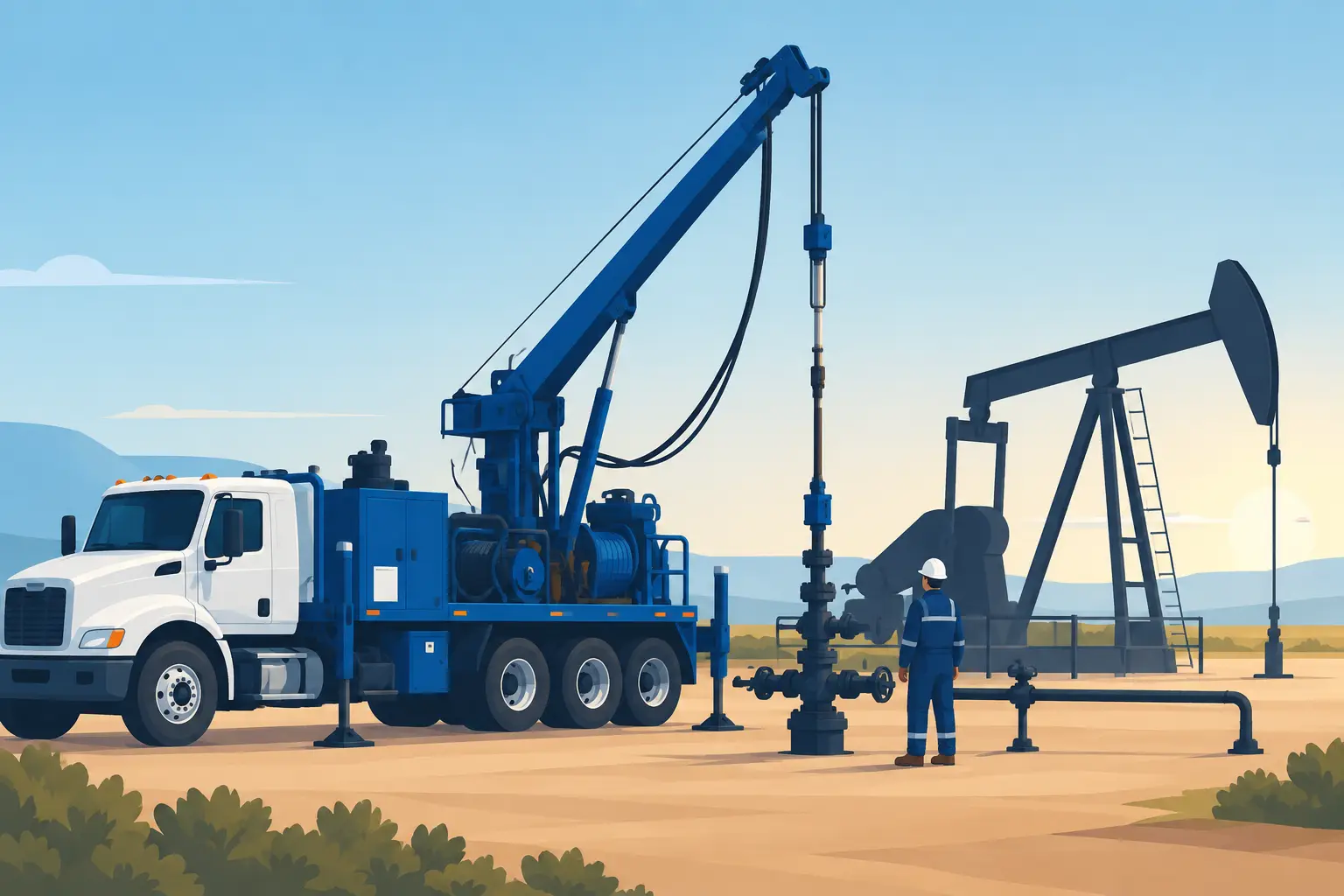
A producing well can tolerate only so much deferred maintenance before a small mechanical issue becomes lost production, a larger repair scope, or a safety concern. Knowing when to use service rigs lets the field team match the right pulling capacity, crew, and support equipment to the job before the well is down longer than it needs to be.
A service rig is not the answer to every well call. Routine inspections, minor surface repairs, chemical treatment, and some flowline work may not require one. But once the job involves pulling rods, tubing, downhole pumps, or completion equipment, a properly staffed rig becomes the practical way to regain control of the well.
When to Use Service Rigs for Workover Work
The clearest reason to mobilize a service rig is a workover that requires work inside the wellbore. Rod and tubing pulls, pump changes, packer work, fishing operations, and repairs to downhole completion components all require controlled handling of tubulars and equipment. Trying to treat this work as a surface maintenance call creates unnecessary exposure and usually adds time once the crew reaches the actual failure.
Pump failures are a common trigger. A well that suddenly loses fluid production, begins pounding, shows abnormal amperage on an artificial-lift system, or delivers erratic rates may have a worn or damaged downhole pump. If diagnostics point to a pump pull, the service rig provides the mast, drawworks, blocks, and crew needed to pull the rod string and tubing, inspect components, and run the replacement assembly correctly.
Tubing integrity problems also belong in the service-rig category. A suspected tubing leak, parted tubing, scale restriction, or corrosion-related failure can mimic other production problems at the surface. Once the repair plan requires pulling tubulars to locate and correct the issue, the rig should be scheduled with the needed handling tools, replacement pipe, and fluid plan already in place.
Workovers are also the right time to address more than the immediate failure. If the well is already open and the string is out, the operator may choose to inspect rods, replace worn couplings, evaluate tubing condition, change pump configuration, or correct recurring issues that have been reducing run life. That decision depends on production economics and the condition of the equipment, but it can prevent a second outage shortly after the first repair.
Completion and Recompletion Operations
Service rigs are frequently used after drilling activity when a well needs completion support, equipment installation, or a planned recompletion. The exact scope varies by well design, but the operating need is consistent: the crew must safely run, retrieve, or manipulate completion equipment under controlled conditions.
For a new completion, the rig may be needed to run tubing, rods, pumps, packers, and associated production equipment after the well is ready for that phase. On an existing well, a recompletion may involve isolating an interval, changing the producing zone, setting or retrieving plugs, or reconfiguring equipment to restore economic production. These are not jobs to schedule around whatever equipment happens to be available. The rig capacity, mast height, pressure-control requirements, and crew experience need to match the planned string and well conditions.
A service rig can also support a planned transition in artificial lift. When production decline, fluid levels, gas interference, or changing well conditions call for a different pump setup, the downhole configuration often has to be pulled and rerun. A deliberate service-rig job allows the operator to make that change with the required tubular handling, fluid containment, and logistics in place.
Signs a Producing Well Needs Rig Support
Production data often gives the first warning, but field observation determines whether the issue has reached the point where a rig is justified. A sudden drop in rate, recurring pump-off behavior, tubing pressure changes, excessive rod wear, fluid leakage, or visible problems at the wellhead may all point toward a downhole repair.
The key question is not simply whether production is down. It is whether the likely repair requires pulling equipment from the well. A low rate caused by a surface control issue, a separator problem, or temporary line restriction may be corrected without a service rig. A low rate tied to failed rods, a damaged pump, leaking tubing, or a stuck downhole component generally will not be.
Repeated short-term fixes are another signal. When the same well receives frequent surface adjustments, chemical treatments, or operational workarounds without a lasting improvement, the underlying issue may be below the wellhead. A focused workover can cost more than a surface call, but continuing to spend on temporary measures while production remains impaired can be the more expensive choice.
Well control concerns change the urgency. If pressure behavior, wellhead condition, or equipment damage creates a potential containment issue, the operator needs the appropriate service-rig and pressure-control plan rather than a routine maintenance response. The job scope may include supporting vacuum trucks, fluid hauling, steam cleaning, hot oiling, or excavation work to restore safe access and manage fluids around the location.
Plan the Job Around More Than the Rig
A rig on location is only one part of a productive workover. The best service-rig jobs are staged before the mast is raised. That means confirming lease-road access, pad condition, overhead clearance, wellhead configuration, expected pull depth, tubing and rod specifications, replacement equipment, fluid volumes, and disposal or transfer requirements.
Fluid handling deserves attention early. Pulling tubulars can generate produced fluids, tank bottoms, and wash water that need to be contained and moved without slowing the crew. A vacuum truck with the right capacity can keep the work area controlled and prevent the rig crew from waiting on third-party transport. Where paraffin, heavy fluids, or flowline restrictions are part of the scope, hot oiling or steam cleaning may need to be scheduled as part of the same operation.
Site conditions matter as much as mechanical scope. Soft ground, poor access, damaged approaches, inadequate pad space, and drainage problems can delay mobilization or create a safety issue around heavy equipment. If excavation, grading, or site repair is needed, address it before the rig arrives. A contractor that can coordinate site development, hauling, fluid service, and rig work reduces handoffs during a time-sensitive repair.
Hauling must also be considered. Replacement tubing, rods, tanks, pulling tools, and support equipment do not arrive by accident. Winch-truck service and Rolling Tailboard Float hauling can be the difference between a planned one-day operation and a crew waiting on a critical piece of equipment. This is especially true on workovers where the final scope changes after the string is pulled and the actual condition of the components is known.
Choosing the Right Service-Rig Response
Not all service-rig work carries the same risk or requires the same setup. A straightforward pump change on a familiar, shallow well is different from a deep tubing pull, a fishing job, or a completion with pressure-control complications. Operators should provide the available well history, current production data, last pulling report, tubular tally, known downhole equipment, and any recent pressure or integrity concerns when requesting a rig.
That information helps the contractor mobilize the right equipment and avoid assumptions at the wellsite. It also supports better decisions on crew size, lifting requirements, fluid handling, and contingencies. In Central Ohio, where schedules can tighten quickly around weather, access, and multiple active locations, local response capacity has real operational value.
Darby Energy brings service-rig crews with more than 100 years of combined operating experience alongside excavation, vacuum truck, hot oiling, steam cleaning, engineering, and hauling support. For an operator, that means the workover can be planned as one field operation rather than split among several vendors with separate schedules.
Do Not Wait for a Manageable Repair to Become a Major Outage
There is a balance between acting too early and waiting too long. Pulling a well without enough evidence wastes time and capital. Waiting through repeated production losses, escalating equipment wear, or an unresolved integrity issue can turn a controlled service-rig job into a longer outage with a larger scope.
Use current production trends, field observations, and well history to make the call. When the repair requires pulling or rerunning downhole equipment, get the rig, fluid plan, access, and haul support aligned before the well dictates the schedule.
Leave a Reply