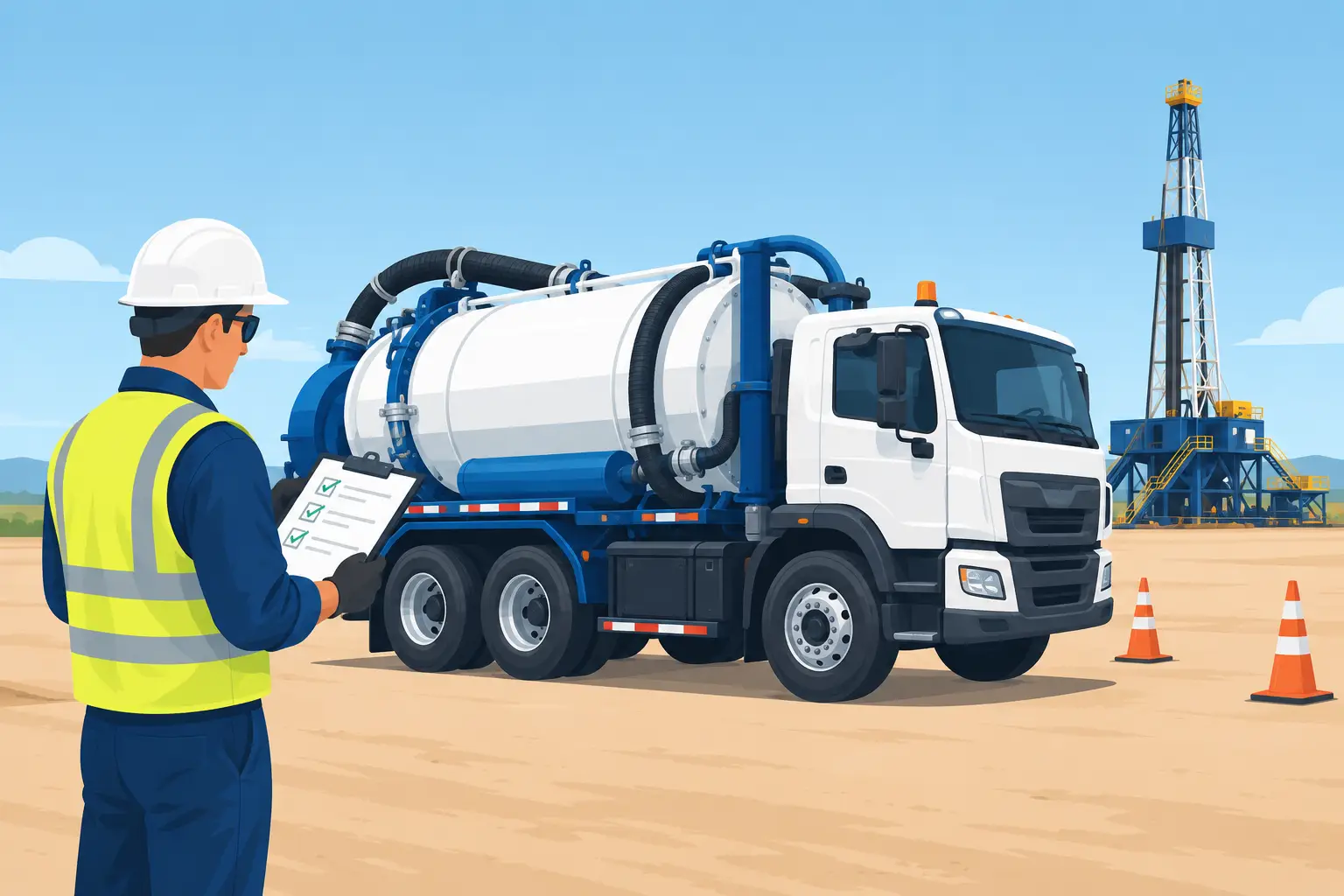
A vacuum truck can arrive on location clean, fueled, and on schedule, then lose the day over a damaged hose, an inoperative relief device, or a missed brake defect. The top vacuum truck safety checks are not paperwork exercises. They are the field controls that keep fluid handling moving without putting the operator, truck, lease, or production equipment at unnecessary risk.
For workover, completion, production, and tank-cleaning support, the inspection needs to match the job. A 90-110bbl truck handling produced water at a congested battery has different exposure than a truck cleaning out a pit or pulling fluid around active well-service equipment. The basic inspection remains consistent, but the hazards, staging plan, and pressure limits need to be reviewed before the unit goes to work.
Top Vacuum Truck Safety Checks Start Before the Drive
The first check happens before the truck leaves the yard. Review the dispatch scope with the operator: material expected, estimated volume, pickup and discharge points, access conditions, required PPE, and whether the work could involve vapor, pressure, heat, or H2S exposure. “Vacuum truck needed” is not enough information for a crew to prepare correctly.
Verify the truck is assigned within its operating limits. Tank capacity, pump capability, hose length, fitting type, load restrictions, and the available disposal or transfer plan all affect whether the unit is right for the job. Sending an undersized truck or incomplete hose package can force field improvisation, which is where minor problems turn into lost time or releases.
The driver should complete the normal road-readiness check before departure. This includes lights, mirrors, tires, wheel condition, brakes, steering, suspension, windshield visibility, horn, backup alarm, fire extinguisher, and required emergency equipment. A vacuum truck is both process equipment and a commercial vehicle. Neither side of that responsibility can be treated as secondary.
Tank, Body, and Access Equipment
Walk the unit before loading or staging. Look for fresh fluid staining, cracked weld areas, corrosion around tank seams, unsecured compartment covers, damaged ladders, loose handrails, and compromised walk surfaces. Check that manways close and secure as designed, gaskets are seated, and access points are not creating a fall or pinch-point hazard.
Pay close attention to the tank’s relief and venting components. A relief device that is missing, damaged, obstructed, or improperly set can turn an otherwise routine transfer into a serious event. The operator needs to know the truck’s vacuum and pressure limitations and must never assume a tank can tolerate conditions outside its rated design.
Inspect placards, markings, and required documentation as part of the walk-around. If the material stream or service conditions require specific identification or transport controls, correct them before the truck is loaded. The right equipment with incomplete markings is still not ready to roll.
Verify the Vacuum System Before Hookup
The vacuum system deserves a deliberate inspection because it carries most of the job’s pressure-related exposure. Check the blower or pump for oil level, leaks, unusual noise, belt or driveline condition, guards, and secure mounting. Confirm all valves move properly and that the operator can identify the correct lineup for vacuum, pressure, transfer, and shutdown.
Hoses and connections require the same level of attention. Inspect suction hose, discharge hose, cam-locks, clamps, gaskets, threaded fittings, reducers, and end caps for cuts, soft spots, abrasion, deformation, corrosion, or evidence of prior leakage. A hose may look acceptable from a distance while a worn coupling or flattened section is close to failure.
Do not use mismatched fittings or temporary workarounds to make a connection fit. If the job requires an adapter, it should be rated for the service and installed so that it cannot separate under vacuum, pressure, vibration, or movement. Safety pins, locking arms, restraints, and hose support are small details until they are not.
Before pulling product, establish that the truck is lined up correctly and the emergency shutdown method is understood. Test communication between the vacuum-truck operator and the person controlling the source vessel or receiving point. Where sightlines are blocked, radios or a designated spotter can prevent a valve-position error or an overfill from becoming a release.
Control the Work Area, Not Just the Truck
A sound equipment inspection will not overcome poor staging. Locate the truck on stable ground with enough room to enter, exit, turn, and respond if conditions change. Consider overhead lines, soft shoulders, slopes, traffic routes, active rig movements, tank-battery congestion, and access for emergency response.
Set the parking brake, use wheel chocks where conditions call for them, and keep the truck clear of ignition sources when handling flammable vapor or hydrocarbon-contaminated fluids. Grounding and bonding requirements depend on the material and transfer configuration, but the question must be addressed before flow begins, not after a static-related incident.
Containment should be in place before connections are made. Drip pans, absorbent materials, plugs, and spill-response equipment need to be accessible rather than buried in a side box. This is particularly important around produced fluids, separator drains, tank bottoms, and locations where a small hose leak can travel quickly through gravel or drainage paths.
Traffic control also matters. Vacuum work often takes place beside haul trucks, service rigs, pickups, and production personnel moving through the same limited footprint. Use cones, barricades, a spotter, or a controlled route when the job creates backing exposure or hose runs across a traffic area. No transfer is routine when the work zone is changing around the crew.
Watch the Transfer From Start to Finish
The pre-job inspection is only useful if the operator stays engaged during the transfer. Monitor tank level, vacuum or pressure readings, hose position, pump sound, and the source vessel’s response. Do not leave an active transfer unattended to handle another task. Overfill events often begin with a few minutes of distraction.
Begin at a controlled rate when conditions are uncertain. This gives the operator time to confirm hose integrity, valve lineup, product behavior, and communications. Once the system is stable, the transfer rate can be adjusted within the equipment’s limits. Faster is not always better, especially with viscous fluids, sludge, mixed loads, or restricted piping.
Know when to stop. Unexpected pressure change, a moving hose, product at an unintended connection, a relief-device concern, loss of communication, or a change in weather or site activity are all valid reasons to shut down and reassess. The right response is not to push through because the truck is already hooked up.
After transfer, drain and cap hoses in a controlled manner, secure all valves and manways, and inspect the truck again for leaks or damage before moving. Confirm load level and weight distribution are appropriate for transport. A truck that was safe at the beginning of the shift still needs to be road-ready after it is loaded.
Make the Inspection Match the Job
The most effective vacuum truck check is specific to the service being performed. A produced-water pull may put the focus on volume control, tank access, and battery traffic. A tank cleanout can require greater attention to vapor exposure, confined-space boundaries, sludge behavior, and residue management. Steam-cleaning or hot-oil support nearby adds heat, hose routing, and ignition-control considerations.
This is where experienced operators make a measurable difference. They recognize when the job scope does not match the equipment on location, when an access road will not support a loaded unit, or when a source tank is behaving outside normal expectations. Those calls should be made early, before a manageable issue becomes a schedule, safety, or environmental problem.
Darby Energy approaches vacuum truck work as part of the larger field operation, not as an isolated pickup. Coordinating fluid handling with workover activity, excavation, hauling, and site access helps crews avoid conflicts that cost time later in the day.
The best closing check is simple: before the truck moves, ask whether the unit, the load, the route, and the next task are all ready. If the answer is not clear, stop long enough to make it clear. That decision protects the crew and keeps the job moving when it matters.
Leave a Reply