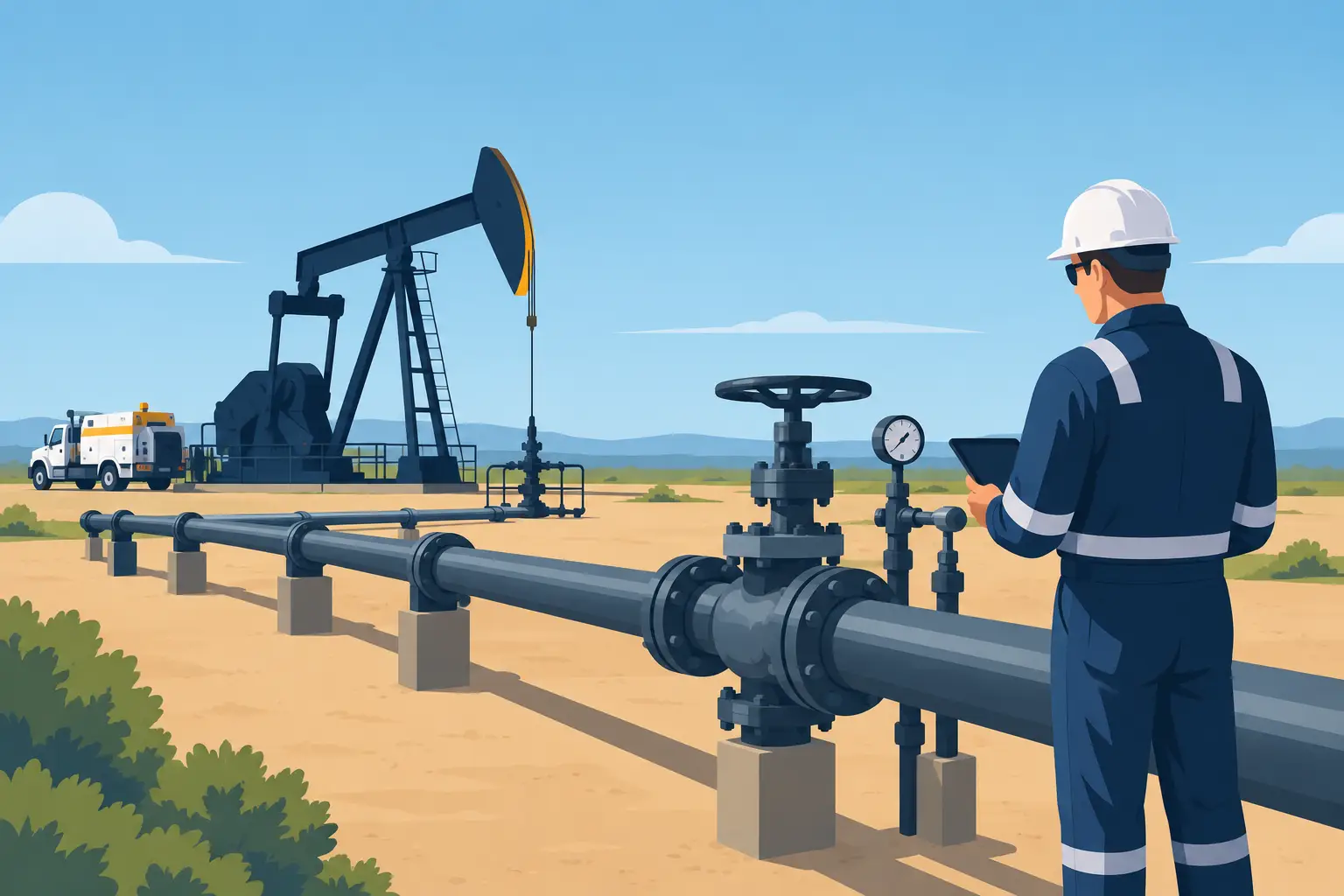
A flowline can look serviceable from the lease road and still be one pressure cycle away from a release, restriction, or shutdown. The question of when to inspect flowlines should be tied to operating conditions, field activity, and production changes – not just a date on a maintenance calendar. A useful inspection program catches deterioration before it becomes a vacuum-truck callout, an environmental response, or lost runtime.
For producing wells, the right interval depends on line age, fluid properties, pressure history, route conditions, and the consequence of failure. A short steel run from a wellhead to nearby production equipment does not carry the same exposure as a buried line crossing a lease road, low area, or active construction zone. Field crews need a schedule that accounts for both.
Start With Routine Lease Observations
The most effective flowline inspections begin with routine field awareness. Every operator checking tanks, separators, pumps, or wellhead equipment is in position to notice a change in the line system. Standing fluid, stained soil, dead vegetation, fresh washout, hydrocarbon odor, unexplained pressure variation, and a change in produced-fluid volume all warrant attention.
This is not a substitute for a documented inspection, but it is the fastest way to identify developing problems. A line that has been stable for months can change quickly after a freeze-thaw cycle, heavy truck traffic, a chemical adjustment, or a well intervention. Production personnel should treat visible route conditions and operating data as part of the same picture.
Aboveground sections deserve close visual review during normal lease visits. Check supports, clamps, connections, valves, unions, abrasion points, low spots, and areas near heat sources. On buried flowlines, inspect the right-of-way and all accessible transition points. A buried line rarely gives a clear warning at the pipe itself. The warning is often at the surface first.
When to Inspect Flowlines Beyond the Routine
Calendar-based inspections remain necessary, but trigger-based inspections are where many failures are prevented. Inspect flowlines promptly when conditions change, especially after events that alter pressure, loading, access, or soil stability.
A more detailed review should be scheduled after:
- a workover, completion operation, shut-in, return-to-production event, or significant change in pump or artificial-lift performance;
- abnormal pressure readings, unexplained volume loss, higher produced-water handling, or a change in fluid appearance;
- freeze-thaw conditions, flooding, heavy rain, washouts, ground movement, or prolonged standing water along the route;
- excavation, grading, mowing with heavy equipment, hauling activity, or any third-party work near the flowline;
- a leak, repair, valve failure, line plug, high-pressure event, or integrity concern on connected production equipment.
These are not identical risks. A flowline coming back online after a shut-in may need attention because temperature and pressure have shifted. A line near a freshly improved lease road may be exposed to compaction or damage from repeated loaded-truck traffic. The inspection method should match the event.
Inspect Before and After Workover Activity
Workover and completion activity changes the risk profile around the wellhead. Crews may move service rigs, winch trucks, fluid-handling equipment, tanks, and support vehicles through areas that are normally undisturbed. Even when the flowline is isolated, it can be affected by vibration, contact, changed drainage, or access routing.
Before equipment mobilizes, identify the line route and mark exposed sections, tie-ins, valves, and crossings. Confirm where heavy equipment will travel, where tanks will be staged, and where vacuum trucks will load. The purpose is not to slow the job down. It is to keep a known line location from becoming an avoidable repair during an active operation.
After the work is complete and the well returns to production, inspect again. Verify that connections remain dry, supports are intact, valve positions are correct, and the route has not been rutted or covered in a way that hides a future problem. If the operation involved pressure testing, hot oiling, fluid circulation, or a change in production configuration, compare the post-job operating pressures and rates with expected conditions.
Watch the Places Where Flowlines Fail First
Corrosion and mechanical damage do not distribute themselves evenly across a line. Inspection time should go first to predictable weak points: wellhead connections, threaded joints, elbows, low points, line supports, road crossings, risers, exposed pipe, and transitions between buried and aboveground sections.
Low points can collect water, solids, and corrosive fluids. Road crossings are exposed to load and vibration. Risers are vulnerable to contact from equipment and weather. At connection points, a small seep can become more visible only after pressure changes or temperature swings. If a line has a history of paraffin, scale, sand, or corrosion, increase the inspection frequency and use operating data to determine whether the issue is recurring.
Older lines need particular attention, but age alone is not the deciding factor. A newer line with poor support, aggressive produced water, damaged coating, or repeated pressure cycling can become a higher priority than an older line operating in stable conditions. The practical question is whether the line’s service history supports confidence in its present condition.
Match the Inspection Method to the Risk
A visual route inspection is appropriate for routine surveillance, but it cannot answer every integrity question. When field evidence points to a leak or restriction, crews may need pressure testing, isolation, line locating, excavation, cleaning, repair, or replacement. The right approach depends on the line material, operating pressure, accessibility, and the consequences of taking it out of service.
Do not use pressure testing as a blanket answer for every line concern. It can require isolation, downtime, fluid handling, and careful control of test conditions. On the other hand, relying only on a visual walkdown can miss a developing internal issue. The decision should be made with the operator’s production, maintenance, and engineering personnel using the available failure history and current field data.
Documentation matters here. Record the date, route, observed conditions, pressure readings where applicable, repairs made, and follow-up required. A concise record helps the next crew understand whether a wet area is new, whether a joint has been repaired before, and whether a line is trending toward repeat failure. Good records also support better decisions on whether continued repair is justified or replacement is the more economical move.
Seasonal Conditions Change the Schedule
Ohio field conditions create practical reasons to inspect more often at certain times of year. Freeze-thaw cycles can shift soil, stress exposed connections, and change drainage around buried pipe. Heavy rain can uncover shallow sections, wash out supports, or create access issues that conceal a release. Dry periods can also reveal settlement and cracking near crossings or trench lines.
Before winter weather tightens access, inspect critical routes, exposed fittings, and lines with prior plugging or leak history. During cold conditions, pay attention to pressure behavior and low-flow situations that can lead to freezing or restrictions. After spring thaw or significant rain, walk areas where water collects and where equipment traffic has cut ruts into the lease.
The interval should tighten when a line is near a creek, drainage path, road crossing, occupied area, or sensitive part of the lease. The cost of a more frequent inspection is usually small compared with an unplanned release, emergency excavation, production interruption, and cleanup coordination.
Build Inspection Into the Field Plan
Flowline integrity works best when it is treated as part of routine lease management, not a separate task that gets deferred until a problem appears. Tie inspections to existing events: tank checks, production reporting, scheduled maintenance, workover planning, site grading, and post-storm reviews. That puts eyes on the line without adding unnecessary trips to the field.
For larger jobs, coordinate the line review with the contractor handling excavation, hauling, fluid handling, and service-rig support. A crew that understands the full work scope can protect line routes during mobilization, maintain access for inspection, and respond quickly if a repair requires digging, fluid removal, or equipment repositioning.
A sound answer to when to inspect flowlines is simple: inspect routinely, then inspect again whenever the well, the ground, or the work around the line changes. Darby Energy can support the field work required to expose, protect, repair, clean up, and return affected production areas to service without adding unnecessary handoffs to the job.
Leave a Reply