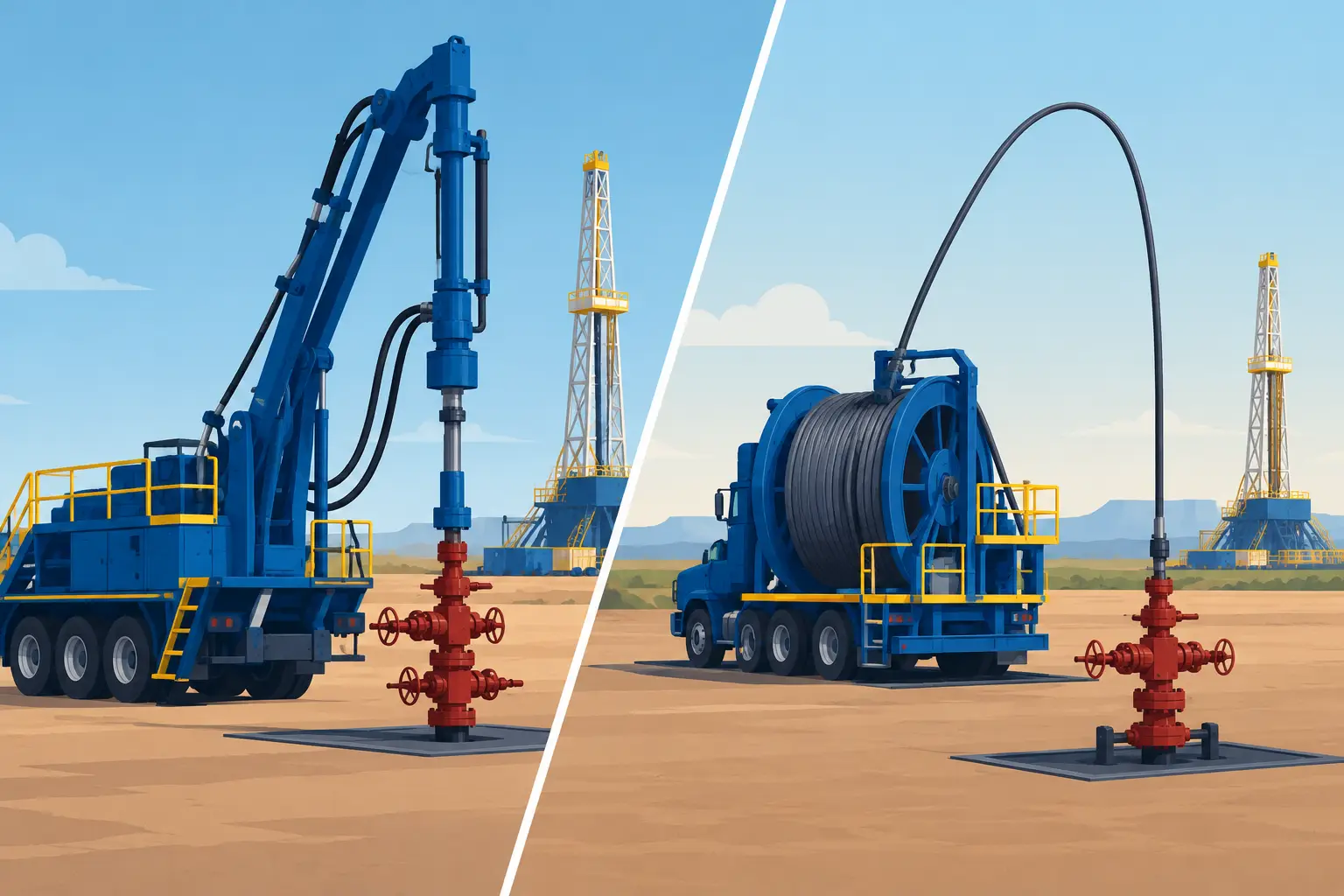
A live-well intervention can look straightforward on the program and still turn into a pressure-control problem once equipment reaches location. The choice between snubbing versus coiled tubing affects more than the workstring. It drives the pressure-control package, crew requirements, access plan, lifting needs, contingency planning, and the amount of mechanical force available at depth.
For operators planning completions, workovers, or production intervention, neither method is automatically the better tool. The right call depends on well pressure, deviation, required bottomhole work, tubular size, available rig-up area, and whether the job needs positive pipe movement or a continuous workstring.
What Separates Snubbing From Coiled Tubing
Snubbing uses a hydraulic workover unit to run and pull jointed pipe under pressure. The unit grips individual tubulars with hydraulic slips and moves them through the pressure-control stack. Its defining capability is controlled push and pull force on a jointed workstring while maintaining well control.
Coiled tubing uses a continuous steel tube injected into the well through an injector head and pressure-control equipment. Because the string is continuous, it can be run quickly without making up and breaking out a connection every 30 feet. That operating speed is a major advantage for many cleanout, circulation, chemical-placement, and light intervention scopes.
The practical distinction is force and flexibility. Snubbing is built for jobs where the well must be worked with heavier jointed tubulars, positive mechanical manipulation, or substantial push-pull capability. Coiled tubing is often the more efficient option where continuous circulation, pumping, logging conveyance, or fluid placement is the primary objective.
Snubbing Versus Coiled Tubing Under Pressure
Pressure is the first screening question, but it is not the only one. Both systems operate with pressure-control equipment, including components such as strippers, rams, lubricators, and BOP arrangements suited to the job. The required working-pressure rating must match the well program, pressure forecast, fluid system, and contingency plan.
Snubbing becomes particularly relevant when well pressure creates an upward force on the workstring. In that condition, crews may need to snub pipe into the well against the well’s lifting force. Once sufficient pipe weight is in the hole, the operation can transition to normal stripping or pull operations as conditions allow. This is not simply a matter of setting equipment over the wellhead. It requires calculated force margins, verified pipe data, tested pressure-control equipment, and crews that understand the transition points.
Coiled tubing manages pressure while the injector head controls the continuous string. It is highly effective for pumping-intensive work, but its available mechanical force is limited by tubing size, injector capacity, well friction, fatigue condition, and the buckling forces encountered downhole. High pressure does not automatically rule out coiled tubing. It does mean the design must account for pressure effects, string forces, and the capabilities of the specific unit and reel.
A useful planning question is this: does the work require moving pipe, or does it require moving fluids? The answer often points the program in the right direction.
Where Snubbing Has the Edge
Snubbing is generally the stronger fit when the intervention calls for jointed tubulars and meaningful mechanical work at depth. Typical scopes can include running or retrieving tubing, wash pipe, workover strings, bridge plugs, packers, or other tools where pipe handling and axial force matter as much as circulation.
It also offers advantages when the job may change once the well is opened. A workover can uncover damaged tubing, a stuck downhole component, or an unexpected need to pull and replace equipment. With a snubbing unit, the operation is already configured around jointed-pipe handling and controlled manipulation under pressure.
That flexibility comes with a larger footprint and more rig-up complexity. Snubbing requires suitable access, stable ground conditions, clearance around the wellhead, pipe-handling space, and a lifting plan. On a tight location, the site-development and logistics work can determine whether the unit can mobilize safely at all.
Snubbing is not a shortcut for poor well planning. It is a specialized pressure-control operation. A program should define anticipated pipe loads, wellhead configuration, BOP stack-up, tubular tally, tool dimensions, pressure test requirements, fluid volumes, and response procedures before the crew arrives.
Where Coiled Tubing Has the Edge
Coiled tubing earns its place when time-efficient deployment and continuous pumping are central to the scope. It is commonly selected for cleanouts, nitrogen lifting, circulation, scale or paraffin treatment, acid placement, milling with appropriate tools, logging conveyance, and other interventions that benefit from pumping through the workstring while moving in the well.
The continuous string reduces connection time and can shorten the operational cycle compared with jointed pipe. On a properly designed job, that can lower exposure time at the wellhead and reduce the number of manual pipe-handling steps.
Coiled tubing can also be a better fit where the task is narrow and defined. If the objective is to reach a target depth, circulate debris, treat a restricted interval, and return the well to production, mobilizing a full snubbing spread may add cost and complexity without adding value.
Its limits must be respected. Highly deviated wells increase friction and raise the risk of lockup or insufficient weight transfer. The tubing cannot be treated as an unlimited workstring. Reel capacity, fatigue history, internal pressure, tensile loading, and buckling limits all affect the safe operating envelope. If the job may require pulling failed tubing, applying high overpull, or running larger jointed tools, coiled tubing may not provide the mechanical margin needed.
Planning the Job Beyond the Intervention Unit
The intervention method is only one part of execution. A well that needs snubbing or coiled tubing also needs a location capable of supporting the operation. That means dependable access, a stable pad, load-bearing ground, clear travel routes, adequate containment, fluid-handling capacity, and enough room for support equipment.
For snubbing, support may include pipe trailers, a crane or winch truck, heavy hauling, vacuum trucks, tanks, and workover support. For coiled tubing, the spread often includes the reel unit, injector, power pack, control cabin, pump equipment, fluid tanks, nitrogen equipment when needed, and returns handling. The total footprint can grow quickly when contingencies are planned correctly.
Fluid management deserves early attention. A circulation or well-control event can change expected volumes in a hurry. Confirm where returns will go, what tankage is available, how fluids will be transported, and how the location will remain workable if weather or traffic affects access. A 90-110bbl vacuum truck may be part of the field-support plan, but it should be scheduled around the expected fluid volume and disposal path, not used as a last-minute answer to an unplanned return.
The same goes for hauling. If the job requires heavy equipment, tubulars, or a pressure-control package with specialized dimensions, hauling and site access should be confirmed before dispatch. A Rolling Tailboard Float or winch truck can solve a transport problem, but only if the route, pad condition, and unload area have been evaluated.
Choosing the Right Method for the Well
Start with the intervention objective. If the work is primarily circulation, treatment, cleanout, or conveyance through a continuous string, coiled tubing may provide the fastest and most economical path. If the work requires handling jointed pipe, retrieving or installing tubular equipment, or overcoming substantial well forces, snubbing may be the more capable method.
Then test that initial choice against the actual well data. Review current shut-in pressures, tubing and casing sizes, completion schematic, deviation survey, known restrictions, fluid properties, target depth, expected loads, and wellhead condition. A choice based only on day rate or prior habit can create unnecessary operational exposure.
The best programs also define the decision points before the job starts. If the cleanout will not circulate at a defined rate, what is the next step? If tubing cannot be moved within planned force limits, is the alternative method already considered? If the well begins taking or producing more fluid than forecast, is tankage and vacuum support available? Clear triggers keep field decisions tied to the program rather than made under pressure.
Darby Energy can support the surrounding field work that keeps a well intervention moving, including site preparation, workover services, fluid handling, hot oiling, excavation, hauling, and petroleum engineering coordination. That integrated support matters when the selected intervention method changes the location requirements or creates a new logistics demand mid-job.
The right equipment is the equipment that gives the crew control of the well and control of the work. Build the plan around the forces, fluids, access, and contingencies in front of you, then mobilize the method that can finish the job without forcing the well to fit the equipment.
Leave a Reply