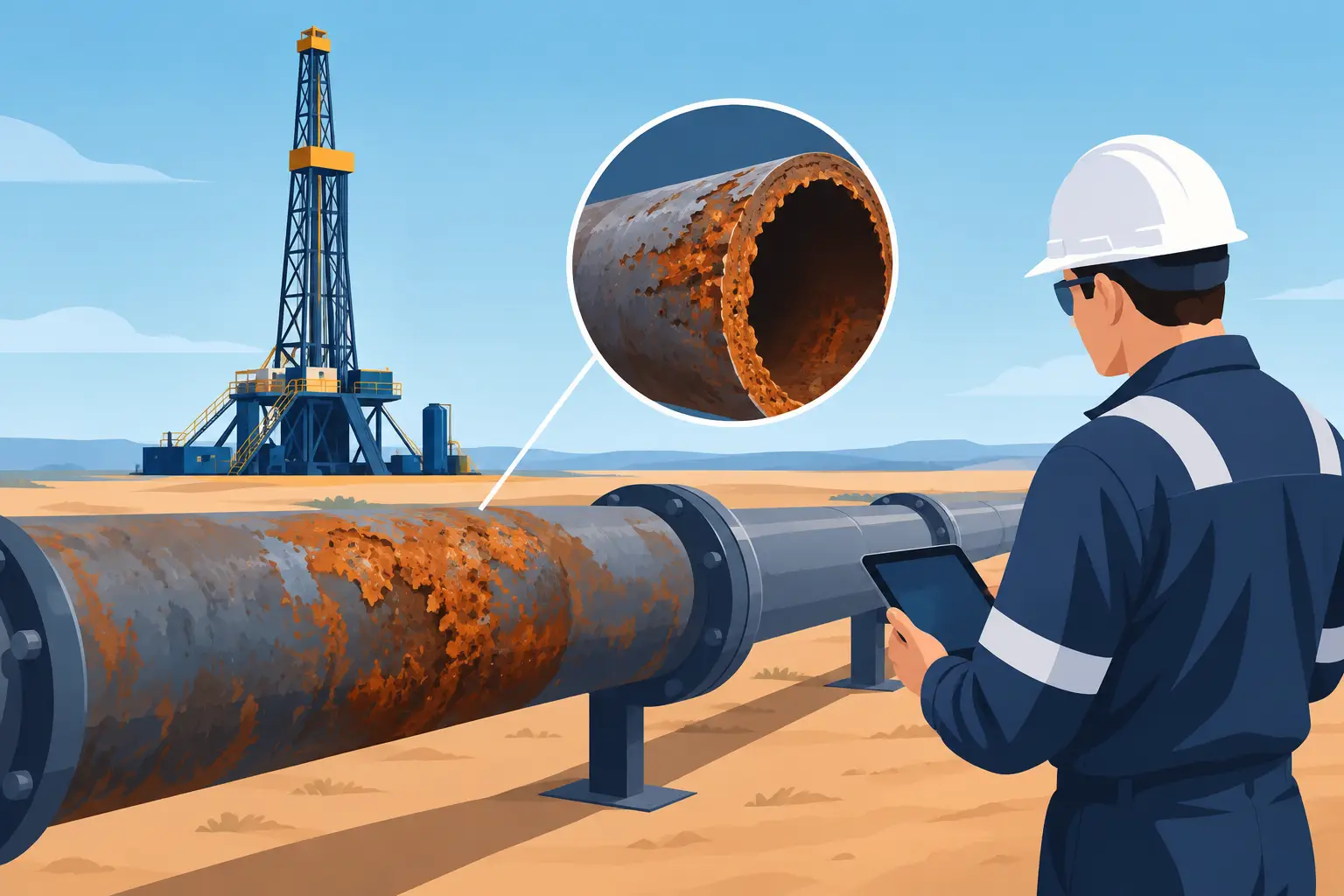
A flowline rarely fails without leaving evidence first. The top signs of flowline corrosion often show up as small operating changes: a wet spot at a connection, unexplained pressure loss, recurring pump issues, or solids where they do not belong. Crews that catch those signals early can plan a controlled repair. Crews that wait may be dealing with a release, shut-in production, environmental exposure, and an urgent excavation.
For Ohio operators working older production systems, corrosion management is not a paperwork exercise. It is a field discipline tied directly to uptime, safe access, fluid handling, and repair readiness. The key is knowing which conditions point to a surface issue and which indicate thinning or attack already moving through the line.
Top Signs of Flowline Corrosion to Watch
Recurring pressure loss or unstable line pressure
A gradual pressure decline can be easy to explain away as changing production behavior, especially on marginal wells. But when tubing, separator, tank, and flowline conditions do not support the change, pressure loss deserves a field check. Internal corrosion can reduce wall thickness until the line begins to seep, while scale, iron sulfide, wax, or corrosion products can restrict flow and create erratic pressure behavior.
Look for pressure that falls during shut-in periods, fluctuates more than normal at a steady rate, or requires repeated adjustments to maintain transfer. Compare current readings against known operating baselines, not just the last gauge check. A line with intermittent restriction may show a different problem than one losing containment, and the repair approach depends on that distinction.
Wet ground, stained vegetation, or a persistent hydrocarbon odor
A small leak does not always create a visible pool. On buried lines, the first indication may be damp soil near a riser, dead or discolored vegetation, a sheen in standing water, or a persistent odor after weather conditions should have cleared it. Around aboveground runs, inspect low points, supports, flange faces, threaded connections, valves, and transitions between dissimilar materials.
Do not assume wet ground is only a produced-water issue. Produced water can carry chlorides, dissolved gases, and bacteria that accelerate external and internal attack. A small water release may also be the visible symptom of a larger integrity issue under insulation, coating damage, or backfill.
Rust staining, coating failure, and pitting at exposed sections
External corrosion is often easiest to see, but not every rusty line is near failure. Surface oxidation on an exposed section may be manageable. The concern rises when coating is lifting, blistering, cracking, or missing and the steel beneath shows localized pits, sharp-edged cavities, flaking scale, or deep rust buildup around welds and fittings.
Pitting matters because it does not reduce wall thickness evenly. A line can look generally sound and still have a localized defect capable of breaking containment. Pay close attention where moisture stays trapped: under clamps, at pipe supports, beneath accumulated debris, near grade transitions, and at spots repeatedly contacted by saltwater, chemicals, or wet soil.
Black solids, scale, or iron deposits in fluids and equipment
Material collected in strainers, tanks, separators, valves, or pigging returns can provide an early read on what is happening in the line. Black iron sulfide deposits, red-brown iron oxide, hard mineral scale, and unusual sediment volume all warrant review. These solids can come from several sources, so they are not proof of one corrosion mechanism by themselves. They are a reason to investigate.
In sour or water-heavy service, iron sulfide may indicate conditions favorable to internal corrosion. Scale can create under-deposit corrosion by holding corrosive water against the pipe wall while reducing the effectiveness of chemical treatment. A line that plugs repeatedly may have a production chemistry issue, a solids-management issue, or corrosion products already breaking loose inside the system.
Pinholes, weeping connections, and repeat repairs in the same area
A pinhole leak is not a minor inconvenience when it appears on a flowline. It is often evidence that localized wall loss has progressed beyond a single defect. Clamp repairs and short spool replacements can restore operations, but repeat leaks near the same route, elevation, or facility tie-in should trigger a wider assessment.
The pattern matters. Multiple leaks on the underside of an aboveground line may point to retained moisture or poor drainage. Leaks at low points can indicate water dropout and internal attack. Failures concentrated around fittings or welds may involve coating breakdown, poor support, vibration, or material compatibility. Treating each leak as an isolated event can turn a manageable integrity program into repeated emergency response.
Conditions That Speed Up Flowline Corrosion
Corrosion rate depends on the fluid stream and the operating environment. Produced water with high chloride content is a common driver, particularly where water settles in low spots or dead legs. Carbon dioxide can form carbonic acid in the presence of water, while hydrogen sulfide introduces additional corrosion and safety considerations. Microbiologically influenced corrosion can also be aggressive when bacteria establish colonies under deposits or in stagnant areas.
Operating conditions matter just as much as chemistry. Low-flow lines, intermittent production, poor drainage, dead legs, changing water cuts, and temperature swings can all create conditions where corrosive fluids remain in contact with steel longer than expected. Mechanical damage from grading, equipment traffic, poor support, or exposed line movement can compromise coatings and create an external corrosion starting point.
There is no single field indicator that identifies the mechanism with certainty. Fluid sampling, solids review, pressure data, visual inspection, and thickness testing work together. The goal is not to label the problem too early. The goal is to determine whether the line can remain in service safely, what repair is required, and what caused the deterioration.
When a Visual Check Is Not Enough
Visual inspection is a practical first step, but buried flowlines and internally corroded lines can look acceptable from the outside. If operating data or field evidence points to loss of integrity, move beyond a walk-around. Ultrasonic thickness readings at targeted locations can identify wall loss on accessible pipe. Excavation may be necessary to inspect suspect buried sections, verify coating condition, and confirm whether corrosion is localized or widespread.
Pressure testing has value when planned and executed with a clear test boundary, proper isolation, and an understanding of the line’s service history. It can demonstrate a line’s ability to hold pressure at that moment, but it does not explain why corrosion developed or guarantee that a damaged section will remain reliable under changing field conditions. Testing should support the repair decision, not replace inspection and engineering judgment.
For recurring failures, document the location, pipe specification, estimated age, fluid characteristics, failure appearance, and repair history. That record helps determine whether a spool replacement is sufficient or whether rerouting, material changes, coating repair, chemical treatment adjustments, or drainage improvements are needed.
Plan the Repair Before the Line Forces It
Once a flowline is suspect, isolate the affected section and manage fluids before opening the system. The field plan needs the right combination of well-service support, vacuum capacity, excavation, hauling, replacement material, and site access. A repair that appears simple can stall quickly if the line is not drained, the location cannot support equipment, or contaminated fluids and soil do not have a clear handling plan.
This is where integrated support reduces downtime. Darby Energy can mobilize excavation, vacuum truck service, hot oiling or steam cleaning where conditions call for it, service-rig support, engineering input, and heavy hauling under one field plan. That matters when a repair requires more than changing a leaking spool and getting back to production.
After repair, confirm that the line is properly supported, protected from vehicle contact, and graded so water does not remain against exposed components. If the original failure involved internal corrosion, review the water chemistry, inhibitor program, low-point management, and solids control before returning to routine operations.
The practical move is to treat the first credible warning as a scheduling opportunity. A planned daylight inspection with the right equipment costs less than a release response at night, in poor weather, or when production cannot wait.
Leave a Reply