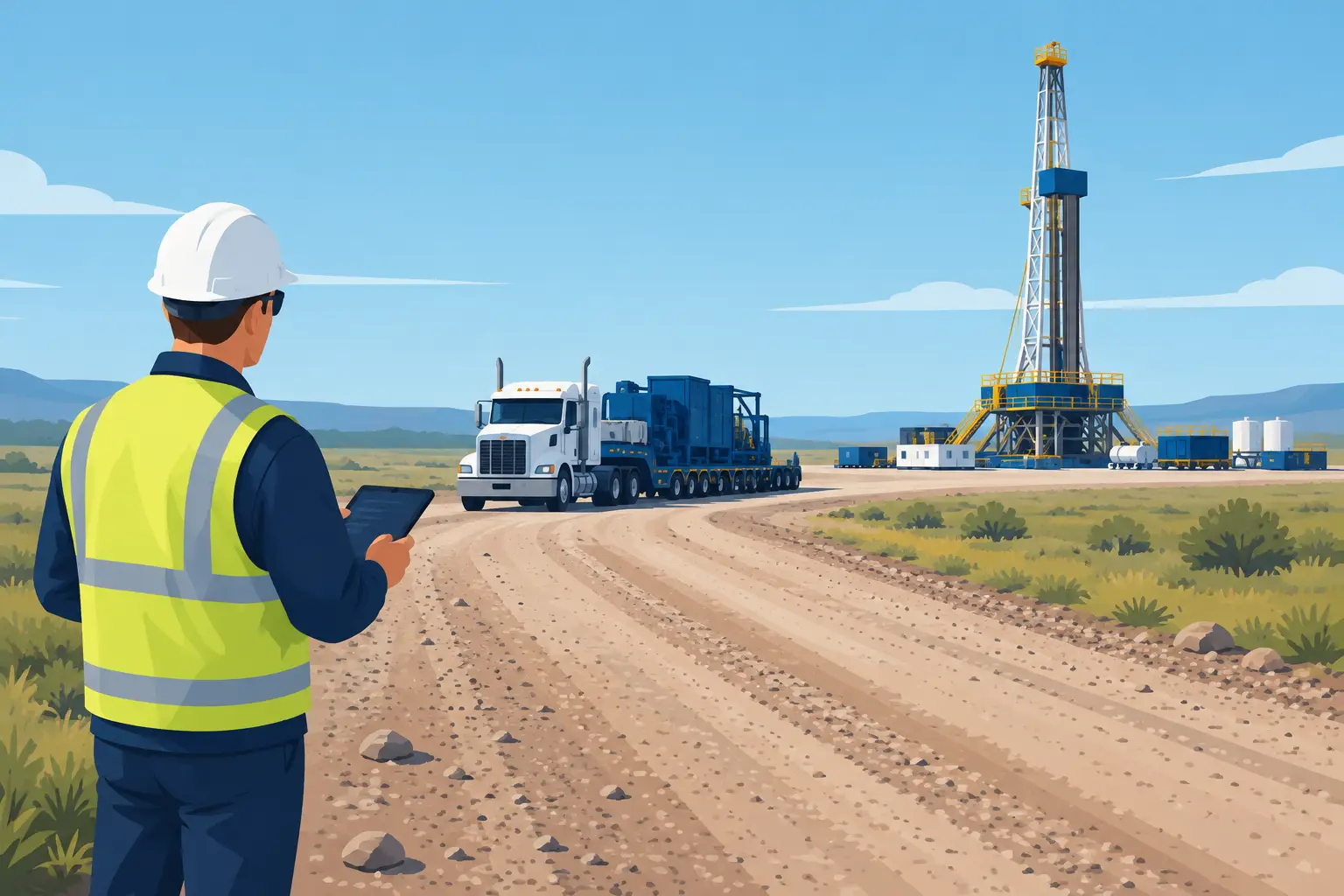
A lease road that looks passable for a pickup can still stop a loaded vacuum truck, service rig, or Rolling Tailboard Float. Knowing how to assess lease roads before equipment mobilizes protects the schedule, prevents recovery work, and gives the field crew a real picture of what the road will support.
For operators and field supervisors, road assessment is not a paperwork exercise. It is a load-path review from the public road to the pad, tank battery, or wellhead. The question is not simply whether a truck can enter. The question is whether every required unit can get in, turn, work, and leave safely under the expected weather and load conditions.
Start With the Planned Equipment and Load
A road condition is only good or bad relative to the equipment using it. Establish the mobilization list before evaluating the route. A light-duty maintenance pickup, a 90-110 bbl vacuum truck, a workover rig, and a winch truck hauling a loaded float place very different demands on the same lease road.
Confirm gross vehicle weights, axle configurations, loaded dimensions, trailer length, turning requirements, and anticipated number of trips. Include support equipment, not just the primary unit. A completion or workover job may require service rigs, fluid handling units, haul trucks, pipe trucks, equipment floats, and material deliveries over a short window. A road that handles one pass may fail after repeated loaded traffic.
The critical assessment is usually based on the heaviest and least maneuverable unit. If a float cannot make a corner without dropping tires off the edge, or a vacuum truck cannot turn around without backing a long distance, the route needs work before the equipment is dispatched.
How to Assess Lease Roads From the Public Road In
Walk or drive the complete route in the same direction the equipment will travel. Begin at the highway or county-road entrance and continue through the lease gate, bends, hills, crossings, and final approach to the work area. Do not limit the review to the last few hundred feet near the well.
Check entrance geometry and visibility
The entrance is often the first restriction. Review the approach angle, ditch depth, culvert location, gate width, overhead utilities, and sight distance for trucks turning off the public road. A tight entrance can force trailer tires into a soft shoulder or place a tractor-trailer too close to traffic while setting up for the turn.
Look for mailbox posts, fence corners, trees, signage, and drainage structures that narrow the usable path. An entrance may need widening, stone reinforcement, culvert extension, or temporary traffic control before a heavy haul arrives. Verify that gates open fully and can remain secured without blocking the travel lane.
Measure usable road width and turning room
Road width must account for tire track, trailer off-tracking, shoulder stability, and safe clearance, not just the apparent width of the gravel. Curves are the primary concern. A long trailer cuts inside the tractor path, especially on sharp turns or hill transitions.
Review every tight corner with the planned equipment in mind. A road may need additional width on the inside of a curve, a flattened ditch slope, or removal of a berm that catches trailer tires. Also check intersections and the pad entrance for room to turn, stage, or back safely.
Backing long distances is sometimes unavoidable, but it should be identified before mobilization. Establish who will spot the move, where traffic will be controlled, and whether the turnaround can support repeated truck traffic without rutting out.
Evaluate the running surface and road base
Surface appearance can be misleading. A dry crust over saturated subgrade may carry a pickup but break under tandem or tri-axle loading. Inspect for pumping, deep ruts, washboarding, potholes, loose stone, exposed geotextile, edge breakup, and areas where prior traffic has tracked into the ditch.
Probe questionable sections and pay close attention to low spots, shaded areas, and locations immediately beyond culverts. In Ohio, freeze-thaw cycles can weaken a road base quickly, while spring moisture and heavy rain can turn a marginal lease road into a recovery job.
The road needs enough base thickness and compaction to distribute wheel loads. Where it does not, the practical fix may be undercutting failed material, placing suitable aggregate, compacting in lifts, and restoring crown. Simply spreading stone over saturated mud often creates a temporary surface that fails under the next loaded truck.
Drainage Determines Whether the Road Holds Up
Most lease-road failures begin with water. A proper crown moves water off the running surface, while ditches, culverts, and outlets carry it away without washing out the road edge. If water is standing in wheel tracks, the road is already losing strength.
Inspect cross-drains and culverts for blockage, damage, settlement, and adequate end protection. Check whether ditches have filled with silt or brush and whether discharge is eroding below the outlet. Water crossing the roadway can undermine the base even when the surface still looks firm.
There is a trade-off in aggressive grading. Cutting a road flat may make it look smooth for a day, but it removes crown and encourages ponding. Grading should restore drainage while preserving enough material and shoulder support for the intended load. On steep grades, water bars, diversion structures, or additional stone may be needed to control runoff and maintain traction.
Review Grade, Cross-Slope, and Traction
Grade matters more when a unit is loaded, when the road is wet, or when the route includes a sharp turn at the top or bottom of a hill. Evaluate whether equipment can climb, descend, and stop without losing traction. Loose aggregate on a steep grade can be as limiting as mud.
Cross-slope deserves the same attention. Excessive side slope increases rollover exposure for vacuum trucks and other high-center-of-gravity equipment, especially when a loaded unit meets a soft shoulder. Identify narrow sections where two vehicles cannot pass without one dropping onto the edge.
If the route includes a creek crossing, low-water crossing, bridge, or private culvert, verify the structure’s condition and load capacity. Do not assume that a crossing is suitable because light production traffic has used it. Heavy hauling imposes a different load case, particularly when a trailer’s axle group concentrates weight near the structure center.
Clear the Vertical and Lateral Obstructions
Assess overhead and side clearance from the road surface, not from where a pickup sits. A loaded float, service rig, or raised stack can encounter tree limbs, utility lines, gate frames, and pipe racks that ordinary vehicles clear without issue.
Check for branches that will sweep mirrors or contact equipment, especially after rain or snow adds weight to vegetation. Identify low lines and confirm their ownership and required clearance before equipment enters the lease. Never treat a suspected utility conflict as a field adjustment.
Lateral clearance also affects crew safety. Brush, steep drop-offs, parked equipment, and narrow shoulders can leave no room for a spotter or emergency access. The route should allow drivers to see hazards early and maintain a controlled path through restricted areas.
Factor in Weather and Traffic Timing
A lease road assessment has a time limit. Conditions can change after a single storm, a hard freeze, or a week of heavy truck traffic. Recheck the route when the weather changes materially between the initial inspection and mobilization.
Schedule can also reduce road risk. Heavy hauls may be better staged before forecast rain, while repeated vacuum-truck traffic may require stone maintenance during a workover rather than after the road fails. If the road will be used at night, review lighting, marker visibility, gate access, and communication procedures as part of the plan.
Field conditions sometimes support a delay better than an attempted move. Waiting for a saturated base to firm up, placing additional aggregate, or changing the haul sequence may cost hours. Recovering a stuck unit, repairing a washed-out road, or losing access to the well can cost considerably more.
Document Deficiencies Before Mobilization
Use photos, route notes, and clear measurements to document restrictions. Mark weak sections, narrow turns, drainage failures, clearance conflicts, and turnaround limits. This allows the excavation crew, hauling crew, and job supervisor to work from the same field conditions rather than assumptions.
The correction plan should be specific: add stone from station to station, clean a culvert, widen a curve, trim designated limbs, reinforce a crossing, or build a turnaround. Assign responsibility and verify the work before dispatching high-value equipment.
Darby Energy approaches lease-road readiness as part of total site execution. When excavation, hauling, fluid handling, and well service are coordinated around the actual route conditions, equipment arrives prepared to work instead of waiting on access repairs.
A road does not need to be perfect to support a job, but it must be adequate for the heaviest move, the current moisture conditions, and the number of loaded passes ahead. Assess it early, correct the weak points, and keep the route under review until the last truck is out.
Leave a Reply