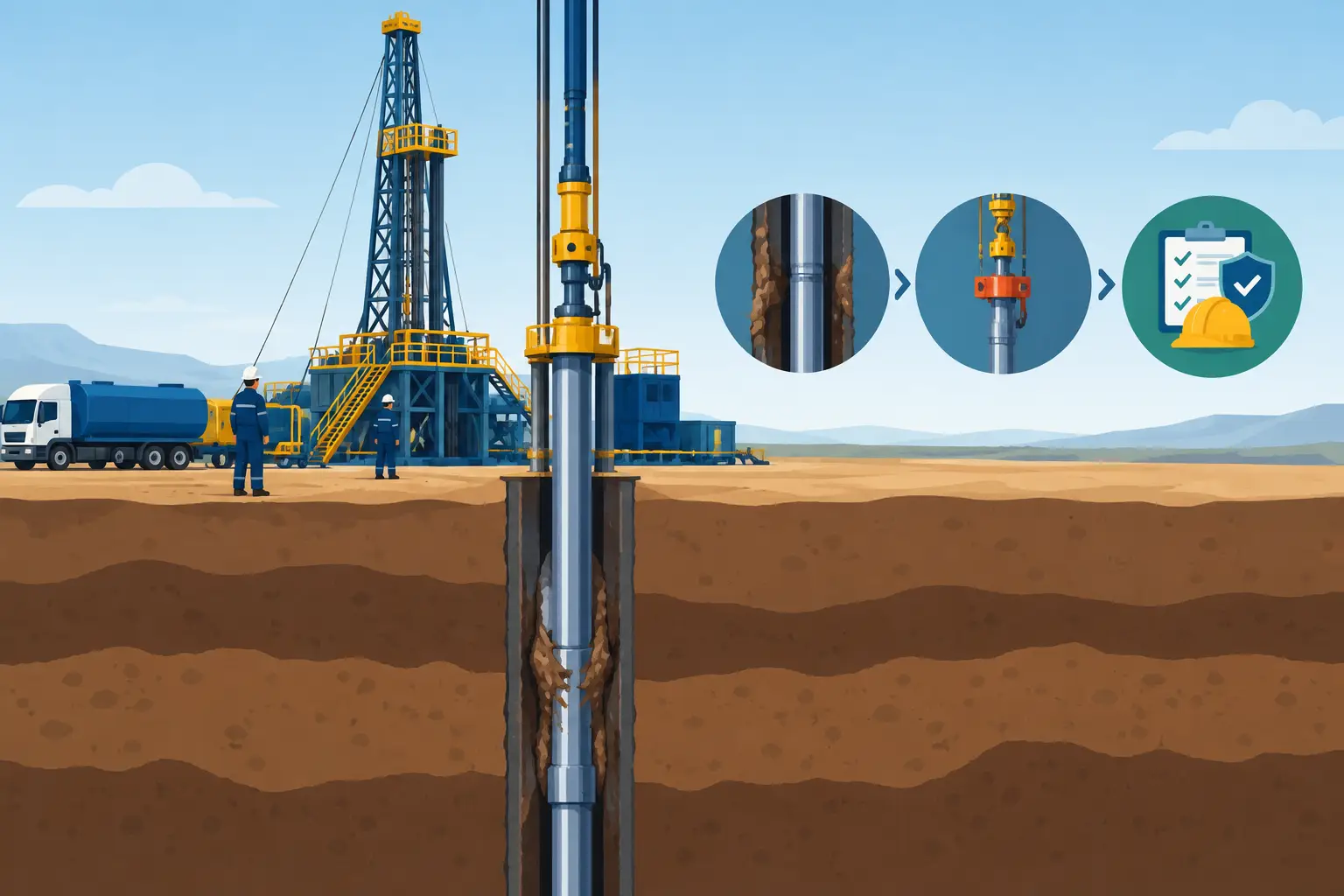
A stuck tubing event turns a routine pull into a decision point. Pull harder without identifying the mechanism, and a recoverable workover can become parted tubing, damaged threads, a fishing job, or a well-control concern. The right response starts with accurate surface data, a clear picture of downhole conditions, and a crew that knows when to work the string and when to stop.
What Stuck Tubing Is Telling You
Stuck tubing is not a single failure mode. It is the result of a force holding the tubing in place that exceeds the available safe pulling force. The crew needs to determine whether that force is pressure-related, solids-related, mechanical, or caused by the condition of the tubing string itself.
The difference matters. A string held by differential pressure will not respond to the same treatment as tubing hung in scale, sanded across a nipple, or mechanically locked at a damaged collar. Running the wrong recovery procedure can load the string unnecessarily while the actual restriction remains untouched.
Before working the tubing, establish the facts available at surface. Record the depth where movement stopped, last free movement, current tubing weight, pump pressure, annulus pressure, fluid level where known, and the sequence of operations leading up to the problem. Compare actual string weight to the expected tally. A small change in the timeline can point to the cause: circulation loss, rising pump pressure, a tight spot on the way in, production of fines, or an abrupt set-down at a known completion component.
Common Causes of Stuck Tubing
Differential pressure sticking
Differential sticking occurs when tubing contacts a permeable zone and the pressure differential presses it against the formation or filter cake. It is more likely where overbalance is significant and the string has been stationary. The tubing may be free enough to rotate or work slightly, but it will not move upward as expected.
The response depends on well conditions and available pressure control. Reducing the differential, where the operating plan allows, can be more effective than applying additional pull. Controlled working of the string, circulation, and appropriate spotting treatment may be considered. The limitation is clear: pressure changes cannot compromise well control or exceed the operating envelope of the completion and surface equipment.
Scale, paraffin, and deposited solids
Production tubing can become restricted by mineral scale, paraffin, iron sulfide, corrosion products, and other deposits. In Central Ohio wells, produced-fluid history and prior treatment records often provide the first indication that deposits may be involved. A steady increase in pulling resistance, restricted circulation, or a string that hangs at a repeatable depth can point toward an internal or external solids problem.
Mechanical removal, chemical treatment, hot oiling, or steam cleaning support may be appropriate depending on the material, well configuration, and where the restriction is located. Heat and chemical treatment are not interchangeable. A treatment selected for paraffin will not solve a hard scale bridge, and aggressive chemistry can create compatibility concerns with elastomers, formation fluids, or handling requirements at surface.
Sand, fines, and fill
Sand production and migrating fines can pack around the tubing, bridge across restrictions, or settle after the well has been shut in. This is especially common when production conditions change, a pump fails, or fluid velocity falls below what is needed to keep solids moving.
If fill is suspected, circulation capacity becomes central to the recovery plan. Confirm the flow path before pumping against a restriction. Pumping blindly can increase pressure, pack solids tighter, or force fluid into an undesirable zone. A controlled circulation program, fluid handling capacity, and clean returns monitoring give the crew a better basis for deciding whether the string can be freed or whether cleanout and fishing tools are required.
Mechanical restrictions and damaged equipment
Mechanical sticking includes tubing caught at a profile, nipple, packer, casing defect, collapsed section, parted component, or damaged completion hardware. It can also result from a bent joint, swollen elastomer, failed pump component, or thread damage that prevents a connection from passing a restriction.
These jobs demand discipline. If the tubing stops at a known depth near completion equipment, verify the tally and prior schematic before applying high overpull. The string may be landed, tagged, or mechanically engaged where it should not be. Pulling beyond the safe working limit can turn a straightforward retrieval into an expensive fish.
A Controlled Stuck Tubing Recovery Plan
The first objective is not maximum pull. It is preserving options. Confirm the service rig’s load indicators, derrick capacity, tubing rating, connections, and pressure-control equipment before the crew begins working the string. The operator, toolpusher or company representative, and service-rig supervisor should be working from the same plan.
Start by checking whether the string can move in either direction. Carefully work up and down within approved load limits while recording every response. Note whether the resistance changes after circulation, after pressure adjustments, or after a short waiting period. Those observations are operational data, not just attempts to free the pipe.
If circulation is available, establish rates and pressures gradually. Watch returns, tank volumes, and fluid condition. A 90-110 bbl vacuum truck can support fluid movement and cleanup logistics when produced fluid, wash water, or recovered treatment fluid must be managed at the job site. The goal is to keep the work area controlled while the well response is evaluated.
Pressure should be treated as a tool, not a substitute for diagnosis. Test only within the approved program and equipment limits. Unexpected pressure behavior may indicate a plugged string, a failed component, a restricted annulus, or a communication path that changes the recovery approach. Stop and reassess if pressure data does not match the expected well configuration.
When the tubing remains immobile, the next step may involve jarring, cutting, backing off, or fishing. That choice depends on string condition, stuck depth, completion schematic, available tools, and the economics of the well. A clean backoff can preserve more of the completion than a forced parting, but it requires reliable depth control and a realistic understanding of torque and connection condition. There is no universal best method.
Avoid Making the Job Worse
Most escalation comes from a few predictable mistakes: exceeding safe overpull, failing to track cumulative string loads, pumping without a confirmed flow path, and changing multiple variables at once. When everything changes at the same time, the crew loses the ability to determine what affected the string.
Maintain a written load and pressure record throughout the operation. Keep the tubing tally current, including every joint pulled, any short joints, pup joints, and tool changes. If the work transitions from recovery to fishing, accurate records save time and reduce the risk of leaving unknown equipment downhole.
Site readiness also matters. A stuck-string job can shift quickly from a short workover to a multi-day operation requiring fluid hauling, excavation for access or containment needs, specialty tools, and heavy transport. Consolidating those field resources reduces handoffs when the original plan changes. Darby Energy supports that kind of execution with experienced service-rig crews, fluid handling, hot oiling, steam cleaning, hauling, and project coordination available around the workover.
Preventing the Next Stuck String
Prevention begins before the tubing is pulled. Review recent production trends, fluid analysis, scale and paraffin history, prior service reports, pump performance, and the current well schematic. A well that has been loading up, producing solids, or showing falling fluid velocity deserves a different plan than a clean, stable producer.
During the job, keep circulation practices consistent, avoid unnecessary stationary time across problem intervals, and use clean, compatible fluids. Monitor torque, drag, pressures, and returns early rather than waiting for a full stop. If a restriction is identified while running in hole, address it before committing more string below it.
The best stuck tubing response is usually the one that protects the well, the crew, and the remaining completion while gathering enough information to make the next move deliberate. When the string stops, slow the operation down long enough to understand why. That discipline is what keeps a difficult pull from becoming a larger recovery operation.
Leave a Reply