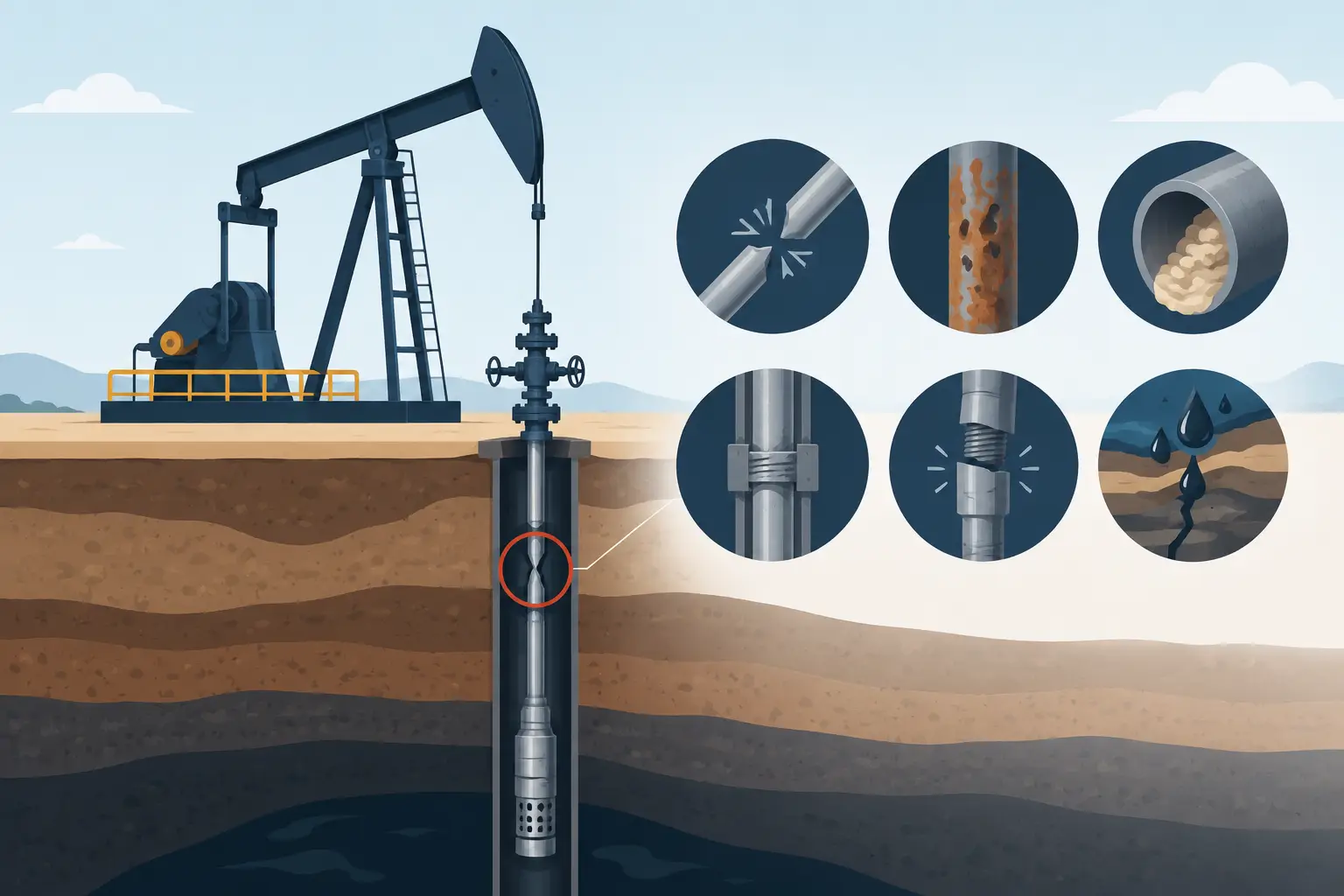
A parted rod can take a producing well offline fast, but the break itself rarely tells the whole story. The top causes of rod failure are usually tied to a repeatable downhole condition: rod-on-tubing contact, cyclic loading, fluid pound, corrosion, buckling, or a string that no longer matches the well’s operating conditions. Pulling the string without identifying that condition only sets up the next workover.
For operators managing mature wells, rod failures should be treated as production and reliability data. Failure location, fracture appearance, rod condition, tubing wear, pump performance, and dyno information can point crews toward the actual mechanism before replacement equipment goes back in hole.
Top Causes of Rod Failure
Rod-on-tubing wear
Rod-on-tubing wear is one of the most common causes of recurring rod failures. It is especially active in deviated wells, crooked holes, wells with doglegs, or any installation where the rod string is allowed to contact tubing repeatedly through the stroke cycle. The wear may begin as polished areas on the rods and progress to tubing cuts, rod body wear, and eventual failure.
Rod guides are often part of the answer, but simply adding guides is not always enough. Guide type, spacing, material, well temperature, fluid chemistry, and placement across known deviation intervals all matter. Worn, missing, or improperly spaced guides can leave the same side-load condition in place while adding unnecessary drag to the string.
A workover crew should inspect the pulled string for polished wear bands and record their depth. That pattern can be matched against the well tally and deviation information to identify where contact is occurring. If tubing has been cut or heavily worn, replacing rods alone is not a repair.
Corrosion and corrosion-fatigue cracking
Corrosion reduces rod section and creates pits that become stress concentrators under normal pumping loads. Produced water, chlorides, carbon dioxide, hydrogen sulfide, oxygen entry, and bacteria can all accelerate the damage. A rod can look serviceable at a glance yet fail at a deep pit after repeated stress cycles.
Corrosion fatigue is particularly costly because it combines chemical attack with normal rod loading. The fracture may start at a small surface defect, then propagate over time until the remaining metal cannot carry the load. Wells with changing water cut, chemical treatment interruptions, or inconsistent fluid handling deserve close attention after a failure.
The corrective action depends on the environment. It may involve improved chemical treatment, coated or corrosion-resistant rod selection, better oxygen control, revised material grades, or a review of whether the current treatment program is reaching the full production system. Pulling failed rods provides an opportunity to inspect for uniform corrosion, localized pitting, scale deposits, and evidence of bacterial activity.
Cyclic fatigue from pumping loads
Every stroke places the rod string through a repeating load cycle. Over time, high peak loads, excessive stress range, or poor rod taper design can produce fatigue failures, often near couplings, upset sections, or damaged rod body areas. A string that was acceptable when the well was completed may become marginal after production changes, deeper pump setting, higher fluid level, or a change in pumping speed.
Load problems should not be judged from surface amperage alone. A current dyno card, fluid level, pump depth, rod tally, tubing condition, and production rate provide a better picture of what the string is carrying. Surface and downhole cards can help distinguish normal loading from fluid pound, gas interference, friction, or an overloaded installation.
Rod design is a field decision with long-term consequences. Upsizing a string may increase capacity, but it can also increase weight and change loading elsewhere in the system. A proper design review balances tensile stress, stretch, stroke length, pump depth, unit geometry, and anticipated operating range rather than selecting replacement rods by availability alone.
Fluid pound and incomplete pump fillage
A pump that is not filling properly can impose sharp impact loads on the rod string. Fluid pound commonly occurs when the pump plunger reaches the fluid level before completing the downstroke, creating a damaging load reversal. Gas interference, pump-off conditions, restricted inflow, leaking standing valves, and excessive pumping speed can all reduce fillage.
The damage may show up as repeated rod parts, loose couplings, pump damage, or erratic production. Reducing speed can help in some cases, but it is not a universal fix. A well with poor inflow may need an adjusted run schedule or pump displacement, while a gas-affected well may require changes to pump setting, gas separation, or operating parameters.
Before running another rod string, verify actual pump fillage and review the dyno card. If the pumping unit is consistently running ahead of the well, a new string is being sent into the same impact cycle that damaged the last one.
Buckling and poor pump spacing
Rods operate in both tension and compression during a pumping cycle. When compression loads become excessive, the lower rod section can buckle, increasing tubing contact and accelerating wear. Buckling is commonly associated with deep pump settings, high friction, high fluid loads, poor spacing, and conditions that push compression farther up the string than expected.
Pump spacing deserves disciplined attention during every workover. An improperly spaced pump can bottom out or tag, generating loads that are difficult to diagnose from production numbers alone. Stretch calculations, tubing movement, temperature effects, and the actual mechanical condition of the unit must be considered before final spacing is set.
Buckling can also be a sign that the installation is fighting a larger mechanical problem. If rods show wear concentrated near the lower end of the string, inspect the pump, tubing, rod guides, and operating card together. Treating only the visible wear usually leaves the compression source unaddressed.
Improper makeup, handling damage, and mixed components
Not every rod failure starts downhole. Damaged threads, bent rods, dropped rods, poor coupling makeup, improper tong use, and contamination on connections can create a weak point before the string ever begins pumping. The risk rises when crews are working against weather, limited daylight, or an urgent return-to-production schedule.
A consistent handling process matters. Crews should inspect threads and couplings, reject bent or visibly damaged rods, keep connections clean, and make up components to the appropriate torque. Rod tally accuracy also matters. A mixed string with undocumented grades, lengths, or connection types complicates load analysis and makes future failure diagnosis less reliable.
Retrieved equipment should be separated by condition where practical. Serviceable rods, rods requiring inspection, and scrap material should not be treated as one pile. Reusing questionable rods may reduce immediate replacement cost, but it can add another pulling job, deferred production, and avoidable service-rig time.
Scale, paraffin, solids, and mechanical drag
Scale, paraffin, sand, and fines can create drag that changes rod loading and interferes with pump performance. In severe cases, deposits restrict tubing, hang up traveling equipment, wear rods, or contribute to poor fillage. The resulting failure may be blamed on the rod string when the root cause is a production-system restriction.
The right response depends on the deposit and where it is located. Hot oiling, steaming, chemical treatment, circulation, cleanout work, or pump service may be appropriate, but the work scope should follow the observed condition. A well producing abrasive solids presents a different equipment challenge than one with wax accumulation or hard mineral scale.
What to Check Before Running a New String
A failure review should begin at the rig floor and continue through the full production system. Record the failure depth and rod number, inspect the fracture surface, document polished wear or corrosion, and compare the physical evidence to the well tally. Then review dyno information, fluid level, pump fillage, tubing condition, pumping speed, stroke length, and recent production changes.
When failures repeat at similar depths, the pattern is valuable. Repeated failures near a deviated interval point toward side wear. Failures in the lower string may indicate buckling, pump spacing, or fluid pound. Random-looking failures can still be linked by corrosion, mishandling, or an overloaded string design. The goal is not to assign one cause too quickly. Many rod failures involve two or more contributing conditions.
For Ohio operators, having workover, fluid handling, hot oiling, hauling, and engineering support coordinated around the same repair can reduce downtime between diagnosis and corrective action. Darby Energy approaches rod work as part of the well’s full operating condition, not as a simple pull-and-replace job.
A clean failure record from each pulling job gives the next crew a better starting point. Over several workovers, those records can show whether a well needs a rod design change, better chemical control, revised pumping parameters, tubing repair, or a more targeted maintenance plan before the next rod parts.
Leave a Reply