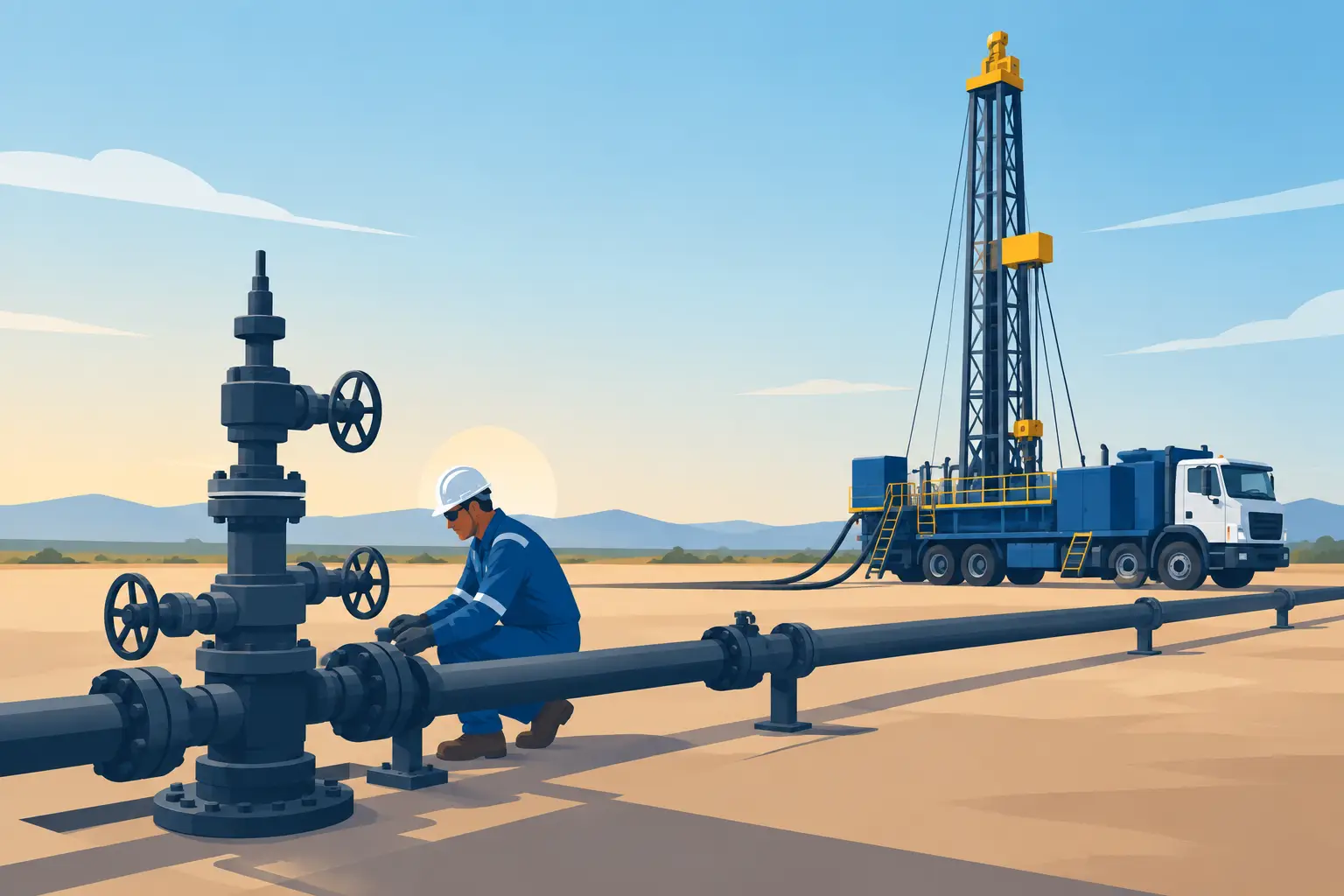
A flowline failure rarely announces itself at a convenient time. It shows up when the well is ready to produce, tanks and trucks are scheduled, crews are committed, and the site is under pressure to move fluid. That is why test flowlines before startup: the test verifies that the line, connections, valves, and associated equipment can hold the conditions the job is about to place on them.
For operators and field supervisors, flowline testing is not a paperwork exercise. It is a direct check on containment, crew exposure, production readiness, and the cost of finding a weak point after fluids are moving. A properly planned test finds problems when they can still be repaired with a controlled shutdown, not during a high-consequence release or an unplanned workover.
Why Test Flowlines Before Startup?
A flowline is only as sound as its weakest component. Pipe body condition matters, but so do hammer unions, threaded connections, welded joints, valve packing, manifolds, seals, fittings, and temporary connections made during the job. A line can look serviceable from the outside and still leak when pressure rises, temperature changes, or vibration begins.
Testing applies a defined pressure for a defined period and gives the crew a controlled opportunity to inspect the system. If pressure drops, a connection sweats, or a valve will not hold, the issue is identified before the line carries produced fluids. This is particularly valuable after a completion, workover, line relocation, repair, or any job where flowlines were broken apart and reassembled.
The practical question is not whether the line held pressure last month. The question is whether this exact assembly, in its current configuration, is ready for the next operating condition. New connections, changed routing, different fluid properties, and a higher expected pressure all change the answer.
Containment Starts at the Connection
Most flowline problems are not dramatic pipe failures. They begin at connection points. A damaged seal, improperly made-up union, worn valve seat, cross-threaded fitting, or section of hose that was not rated for the job can turn into a release once the well comes online.
A pressure test makes those weak points visible before they become active failures. The crew can isolate the section, bleed it down safely, correct the connection, and retest. That sequence takes time, but it is far more controlled than chasing a leak with production underway.
Testing also confirms that isolation is working where it needs to work. Valves that pass fluid internally, valves with damaged packing, and improperly positioned valves can complicate a shutdown when the line is live. Knowing how the system responds under test pressure gives the field team a clearer picture of what can be isolated and where pressure may remain trapped.
Pressure Rating Must Match the Job
The test pressure and procedure must fit the service. Testing too low may fail to expose a problem that appears during operation. Testing beyond the rating of the flowline, equipment, or weakest component creates its own hazard. The applicable operator procedure, equipment rating, fluid service, and expected operating pressure should determine the test plan.
This is where field experience matters. A temporary line used for one operation may not be appropriate for another. Pressure, temperature, erosion, chemical exposure, line age, and connection type all affect what the equipment can handle. A crew should verify ratings and configuration before applying pressure, rather than assuming that equipment used on a prior job is suitable for the current one.
Testing Protects the Schedule, Not Just the Site
Production delays are expensive, but a rushed startup can cost more. A failed flowline after fluids are introduced may require an immediate shutdown, vacuum truck response, repair crew mobilization, cleanup, replacement materials, and another startup sequence. It can also disrupt tank handling, hauling plans, service-rig work, and personnel assigned to other locations.
Testing shifts that risk forward. It puts the repair window before the well is flowing and before the site has multiple moving parts. Even when a test exposes a problem, it has done its job. Finding a leaking union during a scheduled pressure test is not lost time. Finding it after a release is.
The schedule benefit is strongest when flowline testing is coordinated with the full startup plan. The line should be tested after final assembly and before dependent operations are committed. If excavation, well service, hauling, fluid handling, and production personnel are working from the same sequence, the test result becomes a clear go or no-go point instead of a last-minute uncertainty.
A Good Test Requires More Than a Gauge
A pressure gauge alone does not prove the system is ready. The gauge must be appropriate for the expected test range and in usable condition. The test setup must include verified isolation points, controlled pressurization, a safe exclusion area, and a plan for bleeding pressure down after the hold period.
The crew should know which sections are being tested and which components are intentionally excluded. Blind flanges, plugs, valves, manifolds, and temporary test iron all need to be accounted for. A line can appear to hold pressure because the actual test boundary was not what the crew believed it was.
During the hold period, visual inspection matters. Watch for pressure decay, but also look for wet connections, seal movement, unusual sounds, valve leakage, and signs of shifting at supports or transitions. In some cases, a slow leak may not produce an immediate gauge drop, especially on a larger-volume system. A careful walkdown adds information the gauge cannot provide by itself.
Documenting the test also has operational value. Record the tested section, pressure, hold time, gauge used, date, personnel, and any repairs made before retest. The record gives the operator a usable handoff point and helps the next crew understand what was verified. It is especially useful when the site has multiple contractors or when work continues across shifts.
When Flowline Testing Needs Extra Attention
Every test deserves discipline, but several conditions raise the stakes. Recently repaired flowlines, lines that have been moved or exposed during excavation, older pipe with uncertain history, and systems with multiple temporary connections deserve a closer look. So do lines expected to see changing pressure or temperature during startup.
Produced-water service can require particular attention because leaks can create immediate handling and cleanup demands. High-pressure applications, sour service, and flowlines routed near active work areas require tighter control of the test boundary and personnel access. If a line crosses a road, runs near tanks, or ties into a crowded production area, the crew should consider how a release would travel and what equipment would be affected.
There is no single field test that fits every flowline. Hydrostatic testing, pneumatic testing, and other operator-approved methods carry different risks and procedures. Pneumatic testing can store significant energy, so the exclusion zone, pressure-control method, and site-specific procedure deserve additional care. The right method depends on the equipment, service, operator requirements, and conditions on location.
Make Testing Part of the Work Plan
Flowline testing works best when it is built into the job from the start, not added after the line is already assembled. Identify the test boundary during the pre-job discussion. Confirm pressure ratings and test requirements before equipment is mobilized. Make sure the crew has the correct test equipment, replacement seals, fittings, and repair materials available on location.
That preparation reduces the chance that a small failure becomes a multi-hour delay. It also keeps the response organized. If a test fails, the crew should know who has authority to stop work, who will make the repair, how the system will be depressurized, and what must be verified before retesting.
For complex locations, one capable field contractor can simplify the handoff between excavation, flowline access, well service, fluid handling, and hauling. Darby Energy supports that kind of coordinated field execution with experienced service-rig crews, vacuum truck capacity, site work, and heavy-haul support when the job demands more than a single crew on location.
A flowline test is a short, controlled check with a clear purpose: prove the line before the well depends on it. When the test is planned, observed, documented, and repeated after repairs, startup begins with fewer unknowns and the crew has a better chance of keeping the job moving the way it was scheduled.
Leave a Reply