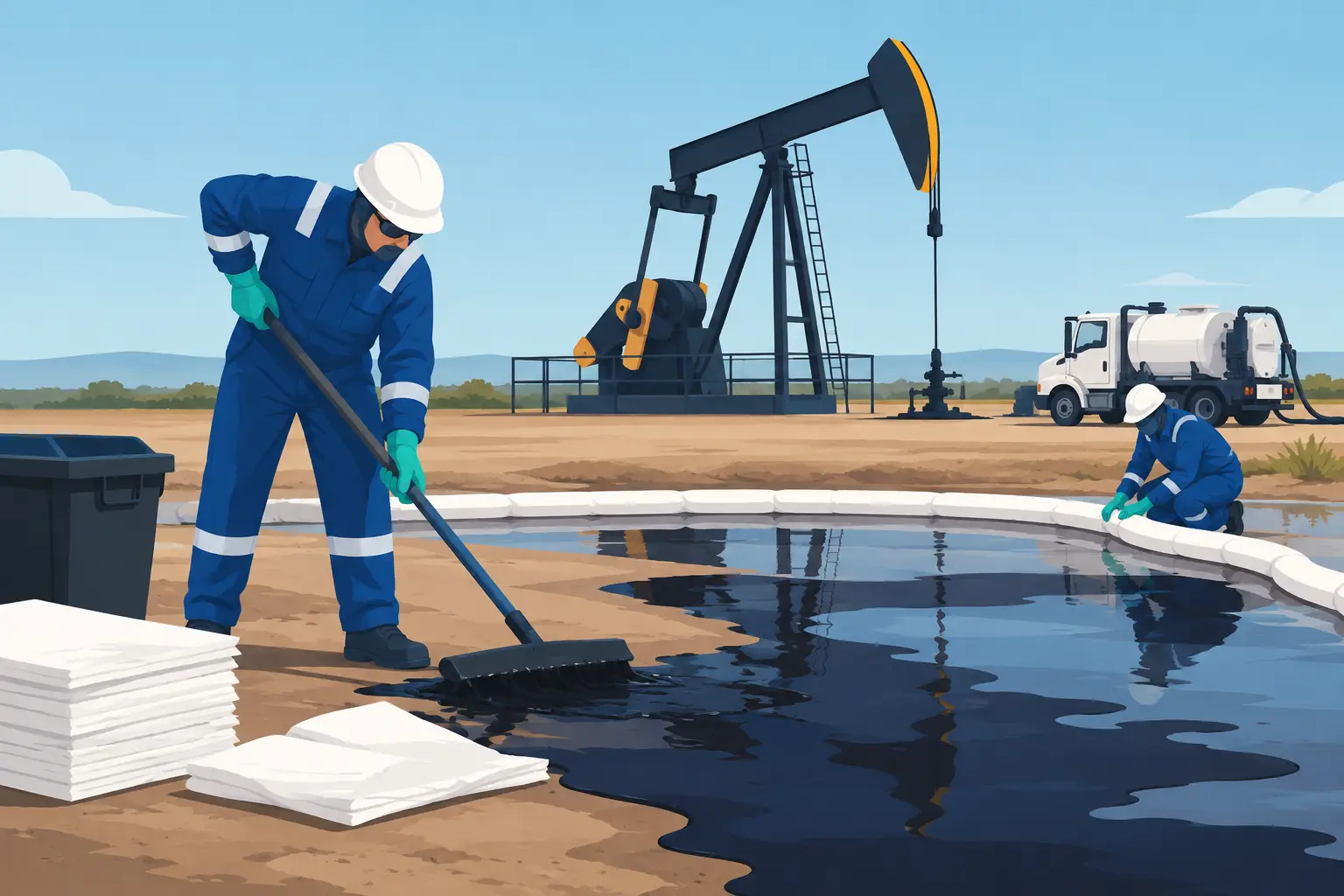
A guide to oilfield spill cleanup starts before the vacuum truck reaches the lease. In the first minutes, the job is to stop the release if it can be done safely, keep fluid out of drainage paths, and establish who is directing the response. A delayed call, an undersized containment effort, or unclear handoff between crews can turn a manageable release into a longer excavation, disposal, and reporting job.
For operators and field supervisors, effective cleanup is not a single service. It is a coordinated field operation involving source control, fluid recovery, excavation, transportation, waste profiling, restoration, and documentation. The right sequence protects people, keeps the site workable, and gives the operator a clean path back to production or scheduled service.
First Response: Control the Release and Protect the Site
The first priority is personnel safety. Establish the work zone, identify ignition hazards, verify the fluid involved, and account for pressure, vapor, traffic, and overhead or underground hazards before equipment is positioned. A tank overflow, produced-water line failure, hose rupture, or workover-related release may look similar from a distance, but each requires a different approach to isolation and recovery.
If the release can be stopped without putting personnel at risk, isolate the source. Shut in the affected line, close the appropriate valve, stop the transfer, or secure the failed connection. Do not send crews into pooled fluid or unstable ground simply to gain a few minutes. A controlled response is faster than recovering from a second incident.
Next, protect the routes the fluid will take. Use berms, socks, absorbent material, temporary pits, or excavation as conditions require. The objective is to keep liquids away from ditches, tile outlets, waterways, access roads, and undisturbed ground. On a tight Ohio lease, drainage can move a release farther than expected, particularly after rain or where a pad has been regraded during construction.
The field lead should also capture the facts while they are still clear: time of discovery, estimated volume, product or fluid type, source, weather, visible migration, actions taken, and equipment on location. Those details support notification decisions, waste handling, regulatory reporting, and a credible closeout record.
Guide to Oilfield Spill Cleanup: Build the Right Response
After the release is stable, the response should be scaled to the actual conditions, not to a generic cleanup plan. A small, contained hydraulic-oil release on compacted gravel needs a different equipment package than produced water that has moved into soft shoulders or crude that has reached native soil.
Vacuum recovery is usually the first major field operation when recoverable liquids are present. Late-model vacuum trucks can pull free fluid from containment, tanks, low spots, and excavations while keeping the work area open for the next phase. Capacity matters, but so does truck access, hose reach, fluid characteristics, and the ability to mobilize without waiting on multiple vendors.
For heavier hydrocarbons, cold conditions, or material clinging to tank bottoms and equipment surfaces, heat may be part of the solution. Hot oiling and steam cleaning can help remove residual product from production equipment, tanks, lines, and work areas. Heat is not automatically the answer. It must match the product, equipment limits, site hazards, and the operator’s recovery plan. Applying it without control can create vapor, pressure, or runoff concerns that complicate the job.
Excavation begins when contamination cannot be recovered from the surface or when field observations show migration below grade. The practical question is not simply whether soil is stained. It is whether the impacted material has been delineated, segregated, loaded, and documented in a way that supports proper disposal and restoration. A competent excavation crew can cut to the needed depth, maintain stable slopes, preserve access for trucks, and keep clean material separate from impacted soil.
On an active lease, that coordination matters. Service rigs, production traffic, tank trucks, and hauling equipment may still need room to operate. The cleanup plan has to account for rig-up paths, turning radius, overhead clearance, and the location of underground lines. Shutting down more of the site than necessary costs time. Leaving too little room for safe equipment movement costs more.
Match Equipment to the Recovery Work
An integrated response reduces handoffs when time is tight. Vacuum trucks handle free-fluid recovery. Excavation equipment opens and restores affected areas. Winch trucks and Rolling Tailboard Float hauling support equipment moves, tank handling, and transport needs. Service-rig crews can assist where the release is tied to well-service activity or production equipment.
That does not mean every spill needs every piece of equipment. A good contractor scopes the work honestly. Small contained events may require recovery, absorbent management, and site cleaning. Larger releases may require multiple vacuum loads, staged roll-off or transport coordination, excavation, sampling direction from the operator or environmental consultant, and final grading. The response should fit the release, the ground conditions, and the operating schedule.
Waste Handling Is Part of the Cleanup
Recovered fluid, spent absorbent, impacted soil, wash water, PPE, and damaged materials do not become someone else’s problem once they leave the lease. They need to be identified, contained, manifested or documented as required, and moved to an approved destination under the operator’s waste plan and applicable requirements.
Keep waste streams separated whenever practical. Mixing recoverable liquids with soil or absorbent can increase disposal volume and cost. Likewise, loading clean gravel, topsoil, or reusable material into the same area as impacted material creates avoidable replacement work. Field discipline at this stage is one of the clearest ways to control a spill’s final cost.
The operator should also verify that load documentation matches what was removed from the site. Volumes recovered by vacuum truck, soil hauled, disposal tickets, and restoration quantities should tell the same story. When records are incomplete, closeout slows down and questions linger after the equipment has left the pad.
Restoration Should Return the Lease to Work
Cleanup is not complete when the visible fluid is gone. The lease must be returned to a condition that supports safe operations and site drainage. That may mean backfilling the excavation with suitable material, compacting in lifts where needed, rebuilding the stone surface, re-establishing berms, repairing access, and grading to prevent future ponding.
Restoration decisions depend on the location. A production pad needs durable traffic-bearing surface and clear tank access. A shoulder beside a lease road may need stabilization before weather turns the repair into a rut. Ground near a ditch or field edge may require additional attention to runoff control. The goal is not cosmetic cleanup. It is a site that can take the next service truck, production check, or heavy haul without creating another problem.
Where confirmation sampling or agency coordination is required, the field work should follow the operator’s approved plan and the direction of qualified environmental personnel. Crews should not guess at closure criteria. Their role is to execute the recovery, excavation, transportation, and restoration work cleanly, safely, and with accurate field records.
Make Spill Readiness a Field Capability
The best spill response begins with preparation that is practical enough to use at 2 a.m. Every active location should have current emergency contacts, basic containment materials, clear access information, and a defined decision path for notifications. Supervisors should know who can authorize excavation, waste transport, tank cleaning, or after-hours equipment mobilization.
It also helps to work with a contractor that can cover more than one piece of the response. Darby Energy can bring vacuum trucks, excavation, hot oiling, steam cleaning, heavy hauling, and experienced oilfield crews into one coordinated field effort. That reduces the lag between recovery, cleanup, and restoration when a release affects an active well site.
When a spill occurs, speed matters, but controlled execution matters more. Get the source under control, keep the fluid contained, bring the right equipment to the lease, and leave the location ready for the work that still has to get done.
Leave a Reply