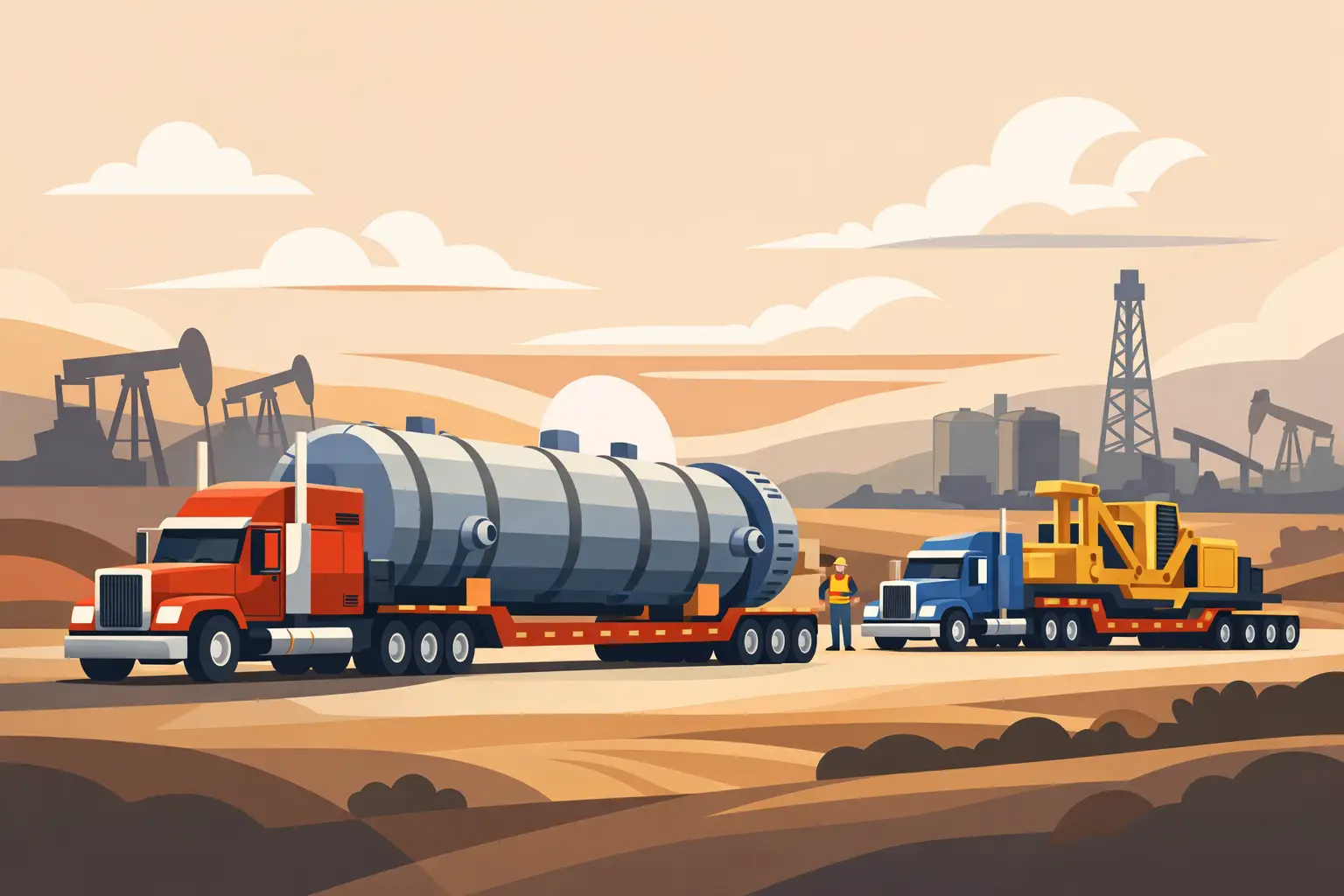
A stalled load can put a completion, workover, or production repair behind before the crew ever reaches the well. Oilfield heavy hauling is not simply moving equipment from one location to another. It is the field coordination required to get rigs, tanks, support equipment, and oversized loads to the right pad, in the right order, with site conditions and the operating schedule accounted for.
For Central Ohio operators, the haul is often where the plan meets reality. Narrow township roads, soft access lanes, changing weather, active construction, and limited pad space all affect how a load can be mobilized. The right hauling partner works from the job sequence backward, not from an open spot on a dispatch board.
What Oilfield Heavy Hauling Must Accomplish
A heavy-haul move has one basic purpose: keep equipment available when the next operation needs it. That requires more than a capable truck. It requires accurate load information, equipment matching, route awareness, experienced operators, and communication with the superintendent or field foreman who is managing the location.
On a workover, a late rig component or tank can delay the whole spread. During site development, equipment arriving before the access road or pad is ready creates congestion and unnecessary handling. During a production maintenance job, the load may need to be placed where it can be put to work immediately without blocking vacuum trucks, service vehicles, or fluid transfer operations.
The best hauling plan accounts for the operation before the truck is loaded. It identifies what is moving, where it will be staged, what equipment must arrive first, and what has to leave before the next unit can enter. That sequence reduces idle time, double handling, and avoidable exposure on the location.
Equipment matching is the first decision
Not every load belongs on the same trailer. Weight, dimensions, ground clearance, center of gravity, loading method, and site access all determine the right setup. A load that appears straightforward on a hard industrial yard can become a difficult move once it reaches a sloped lease road or a confined well pad.
A winch truck is built for field transport and controlled loading of oilfield equipment. It is often the practical choice when equipment must be pulled onto the trailer, positioned with precision, or handled at a location without ideal loading infrastructure. Winch capacity, trailer configuration, and the operator’s control of the load matter as much as the horsepower moving it down the road.
A Rolling Tailboard Float provides another essential option for equipment that needs a lower loading angle and direct access to the deck. It is well suited for moving machinery and field assets where loading clearance, stable transition, and efficient offloading are critical. The right float configuration can limit the need for additional handling equipment at the origin or destination.
Planning the Haul Around the Field Schedule
The haul should support the operation, not force the operation to work around transportation. That sounds basic, but it is where many field moves lose time. Dispatching a truck without confirmed load readiness, route conditions, destination access, or receiving-crew availability can turn a short move into a full-day disruption.
Before mobilization, the hauling scope should answer practical questions. Is the equipment ready to load when the truck arrives? Is the route suitable for the load and current weather? Has the pad been prepared to receive the equipment? Is there room to turn, back, unload, and exit without blocking active work? Are there local restrictions, permit requirements, or utility clearances that affect timing?
Those details are especially important for projects with multiple service lines. A site-development crew may be building access while a well-service team prepares for a workover. Vacuum trucks may be scheduled for fluid handling while a hot oiler or steamer is expected later in the shift. Heavy hauling needs to be coordinated with that sequence so equipment lands where it can be used, not where it has to be moved again.
For an operator managing several vendors, every handoff adds another failure point. Using one field contractor for excavation, site support, well service, fluid handling, and hauling can tighten communication between the people preparing the location and the people delivering the equipment. It does not eliminate planning, but it reduces the number of parties trying to solve the same access or scheduling issue from different directions.
Site Access Changes the Move
Central Ohio well locations can vary sharply from one job to the next. A load may travel from a stable yard to a rural access road with soft shoulders, steep approaches, limited sight distance, and restricted turning room. Conditions can change again after rain, freeze-thaw cycles, or sustained truck traffic.
That is why access should be evaluated as part of the haul, not as a separate concern. If the road needs stone, grading, ditch work, culvert attention, or pad improvement before a loaded truck arrives, that work should be identified early. A truck waiting at the gate helps no one, and an attempted move on poor access can create recovery work that costs far more than proper preparation.
Ground conditions at the destination matter just as much. The unloading area must carry the load without rutting, settling, or creating unsafe angles. The crew needs a clear work zone, stable footing, and enough space to manage the truck and trailer without placing people between equipment or near uncontrolled movement.
There is a trade-off in every access decision. Building a wider, harder route may add upfront cost, while using the minimum available route can increase transport time, recovery risk, and future maintenance. The right choice depends on the number of anticipated loads, equipment weights, weather outlook, and how long the location will remain active.
Load Securement and Controlled Placement
Heavy hauling is not finished when the trailer reaches the lease road. Loading, securement, transit, offloading, and placement are one continuous operation. Each stage needs the same level of attention because a well-planned route cannot compensate for poor load balance or an improvised unloading area.
Securement must be selected for the equipment being moved and checked throughout the trip. Field equipment can have irregular shapes, exposed components, and weight distribution that differs from conventional construction loads. The hauling crew needs to understand where the load can be secured, how it will react during loading, and what changes when the trailer transitions over uneven terrain.
Placement at the site should be deliberate. Equipment needs to be positioned for the next crew, with access for hookup, inspection, maintenance, and eventual removal. Dropping a load in the first available opening may save a few minutes at arrival, then cost hours when a service rig, vacuum truck, or support unit needs to work around it.
Clear communication is part of controlled placement. The driver, spotter, and receiving crew should agree on the unloading path and final position before the trailer is committed to the location. When visibility is restricted or the pad is crowded, slowing the move down is often the correct call. Speed is valuable only when the load remains under control.
Why Field Experience Matters on Heavy Moves
Transportation capacity is easy to claim. Consistent execution comes from people who understand how oilfield work unfolds after the truck arrives. Experienced operators recognize the difference between a load that can be delivered and one that can be delivered safely, placed efficiently, and removed later without creating a problem for the next phase.
That experience also supports better decisions when the plan changes. A road may soften overnight. A rig may run longer than expected. A tank may need to be relocated before a fluid-handling crew can enter. The response is not always to push harder. Sometimes the practical answer is to adjust the sequence, improve access, stage equipment off-site, or send a different hauling configuration.
Darby Energy supports these decisions with winch-truck transportation and Rolling Tailboard Float heavy hauling backed by field-service, excavation, and project-support capability. That combination matters when the load, the road, and the work scope all need attention at the same time.
When a move is tied to an active well schedule, provide the hauling scope early: equipment dimensions and weight, origin, destination, load-ready time, required delivery window, and current site conditions. That gives the crew time to match the truck and trailer to the work, confirm access, and make the haul a controlled part of the operation rather than the reason it stops.
Leave a Reply